
You can make authentic Finnish ruisleipä recipe at home with just rye flour, water, salt, and a sourdough starter or leaven—no fancy equipment required.
This Finnish Ruisleipa recipe gives you a dense, tangy loaf that stays fresh for days and brings a genuine taste of Finland to your table.
You’ll find out what makes traditional ruisleipä stand out from other rye breads, get those simple ingredient ratios you can actually trust, and follow a step-by-step method so you can bake without second-guessing yourself.
I’ve tossed in some practical baking tips to help you wrangle the sticky rye dough, shape that classic flat loaf, and coax out deep flavor from a long, slow fermentation. If you’ve never tried a Finnish Ruisleipa recipe before, don’t worry—it’s easier than it sounds.
Description, Recipe and Historical Information
Ruisleipä is a dense, tangy Finnish rye bread that really centers your meal with sturdy, honest flavor. When you slice it, you taste whole-grain rye, a firm crumb, and a naturally sour note. It’s kind of addictive, honestly.
A basic Finnish Ruisleipa recipe calls for rye flour, water, salt, and a rye starter or sourdough culture. Usually, you mix the starter with lukewarm water and rye flour, let it ferment for a good while, shape into round or oblong loaves, and bake until the crust turns deeply browned. The process sounds simple, but it does take a bit of patience.
Traditional bakers use 100% or nearly all rye flour, plus a long fermentation, to get that acidity and keep the bread fresh for days. Rye’s low gluten keeps the loaf dense, so you want to handle the dough gently—no need to knead it like a wheat bread. The Finnish Ruisleipa recipe really rewards a slow, steady approach.
Ruisleipä has deep roots in Finnish food culture, serving as an everyday staple and a symbol of national culinary identity. Regional variations? Oh, plenty. Eastern styles often come out as round, rustic loaves, while western versions might be lighter or shaped differently. If you’re after practical tips and truly authentic technique, check out a Finnish Ruisleipa recipe that covers starter maintenance and baking tricks, like this detailed Ruisleipä recipe and background. It’s worth a look, even if you’re just curious.
Trying out a Finnish Ruisleipa recipe at home might feel intimidating at first, but honestly, it’s more forgiving than you think. The dough’s sticky, sure, but that’s part of the charm. The real magic comes from the long fermentation—let it go overnight if you can. That tangy, earthy flavor? You can’t rush it. And if your first loaf isn’t perfect, so what? Every Finnish Ruisleipa recipe has its quirks, and you’ll find your own rhythm after a couple of tries.
So, if you’re looking for a bread that lasts, tastes like real food, and connects you to a whole tradition, this Finnish Ruisleipa recipe is absolutely worth a shot. Serve it with butter, cheese, or just as is—it’s surprisingly versatile. And hey, even if you mess up the shape or the crumb, you’ll still end up with something hearty and satisfying. Isn’t that kind of the point?
Give this Finnish Ruisleipa recipe a go, and don’t be afraid to experiment a little. Rye bread loves patience, but it doesn’t demand perfection. That’s what makes it so appealing, at least to me. Good luck—and happy baking!
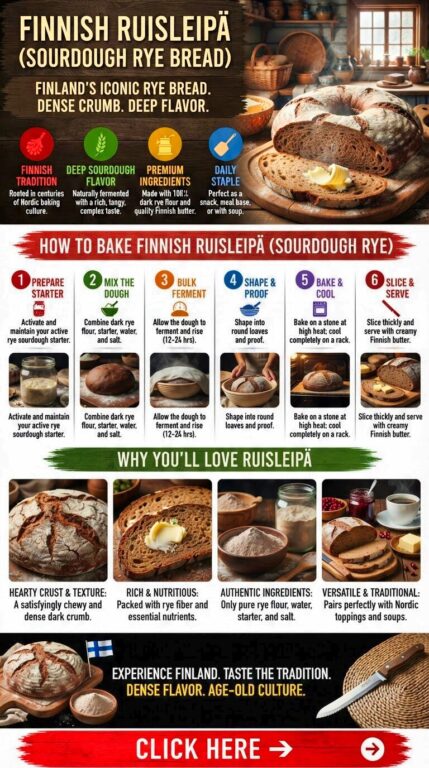
Cooking Tips
If you want a Finnish Ruisleipa recipe that actually tastes right, start with a lively rye sourdough starter. Feed it about 6–12 hours before you bake—make sure it’s really bubbling and smells tangy.
Honestly, just use a scale. Rye flour’s all over the place when it comes to density, so measuring by weight is the only way to nail the crumb every time. It’s one of those little things that makes a big difference in any Finnish Ruisleipa recipe.
Go easy on the mixing. Rye doesn’t have much gluten, so if you knead it like wheat bread, you’ll just get a heavy, weirdly sticky loaf. Gentle hands, less work—trust me, your Finnish Ruisleipa recipe will thank you.
Hydration’s a bit of a dance. Rye soaks up water like crazy, but too much and you’re in trouble. I usually start with less water and add a splash at a time if the dough feels stiff. It’s all about feel, especially with a Finnish Ruisleipa recipe.
Let the dough ferment somewhere cool. If you rush it at room temp, the flavor just isn’t the same. Cooler, slower fermentation builds that deep, classic tang you want in a Finnish Ruisleipa recipe.
Shape the dough in a pullman pan or a round tin—these pans help hold the dense dough together and create that signature tight crumb. That’s pretty much non-negotiable for a real Finnish Ruisleipa recipe.
Before baking, score or press a pattern on top. I usually just use a fork to make a lattice or a cross—don’t go too deep. It’s not just for looks; it helps the loaf expand the right way. Every Finnish Ruisleipa recipe I’ve seen does this.
Get some steam in your oven for the first 10–15 minutes to toughen up the crust. I just toss a tray of hot water on the bottom rack or give the loaf a quick mist. That little trick makes a big difference in any Finnish Ruisleipa recipe.
Wait until the bread’s fully cool before you slice it. Seriously, if you cut it early, it gets sticky and the crumb falls apart. I know it’s hard to wait, but it’s a must for a Finnish Ruisleipa recipe to turn out right.
Wrap the loaf in a cloth or slip it into a paper bag. That keeps the crust from getting soft but stops it from drying out. For longer storage, I just freeze slices and toast them straight from the freezer—works perfectly for a Finnish Ruisleipa recipe.
Looking for more traditional takes or want to riff on your Finnish Ruisleipa recipe? There’s a solid collection of recipes and a pretty thorough guide at Finnish Rye Bread with starter. It’s worth checking out if you’re obsessed with getting your Finnish Ruisleipa recipe just right.
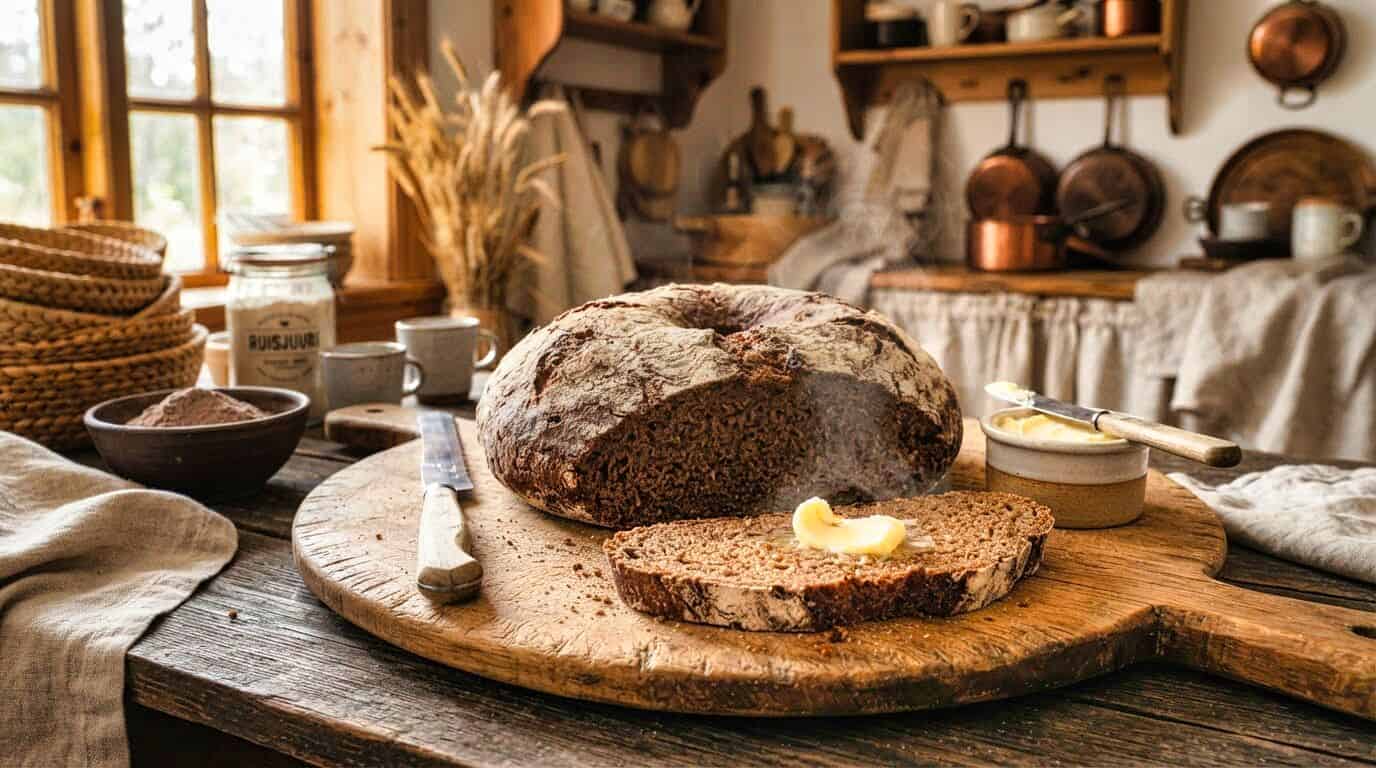
Finnish Ruisleipa Recipe
Ingredients
- 3 cups rye flour
- 1 cup all-purpose flour
- 1 tsp salt
- 2 tsp caraway seeds
- 2 tsp active dry yeast
- 2 cups warm water
- 1/4 cup molasses
Equipment
- large mixing bowl
- 9-inch (23 cm) loaf pan
- Plastic wrap
- Measuring cups and spoons
- Spatula
- Oven
Instructions
- In a large mixing bowl, combine the rye flour, all-purpose flour, salt, caraway seeds, and yeast.
- Add the warm water and molasses, and stir until a sticky dough forms.
- Cover the bowl with plastic wrap and let it rest at room temperature for 12-24 hours.
- After the dough has rested, preheat your oven to 450°F (230°C).
- Grease a 9-inch (23 cm) loaf pan and dust it with rye flour.
- Transfer the dough to the loaf pan and smooth the surface with a spatula.
- Bake for 35-40 minutes, or until the bread is golden brown and sounds hollow when tapped on the bottom.
- Let the bread cool completely before slicing and serving.
Notes
Tips and Tricks
Use warm water to activate the yeast, but not too hot or it may kill the yeast. Let the dough rest for at least 12 hours, but up to 24 hours for more flavor development. Use a spatula to smooth the surface of the dough in the loaf pan before baking. Use a sharp serrated knife to slice the bread for the best results.
Recipes are gathered in person and written for real-world cooking conditions.
- 10 Hungarian Dessert Recipes Passed Down Through Generations - July 25, 2026
- 11 Easy English Recipes Anyone Can Make - July 25, 2026
- Hungarian Kifli Recipe - July 25, 2026