
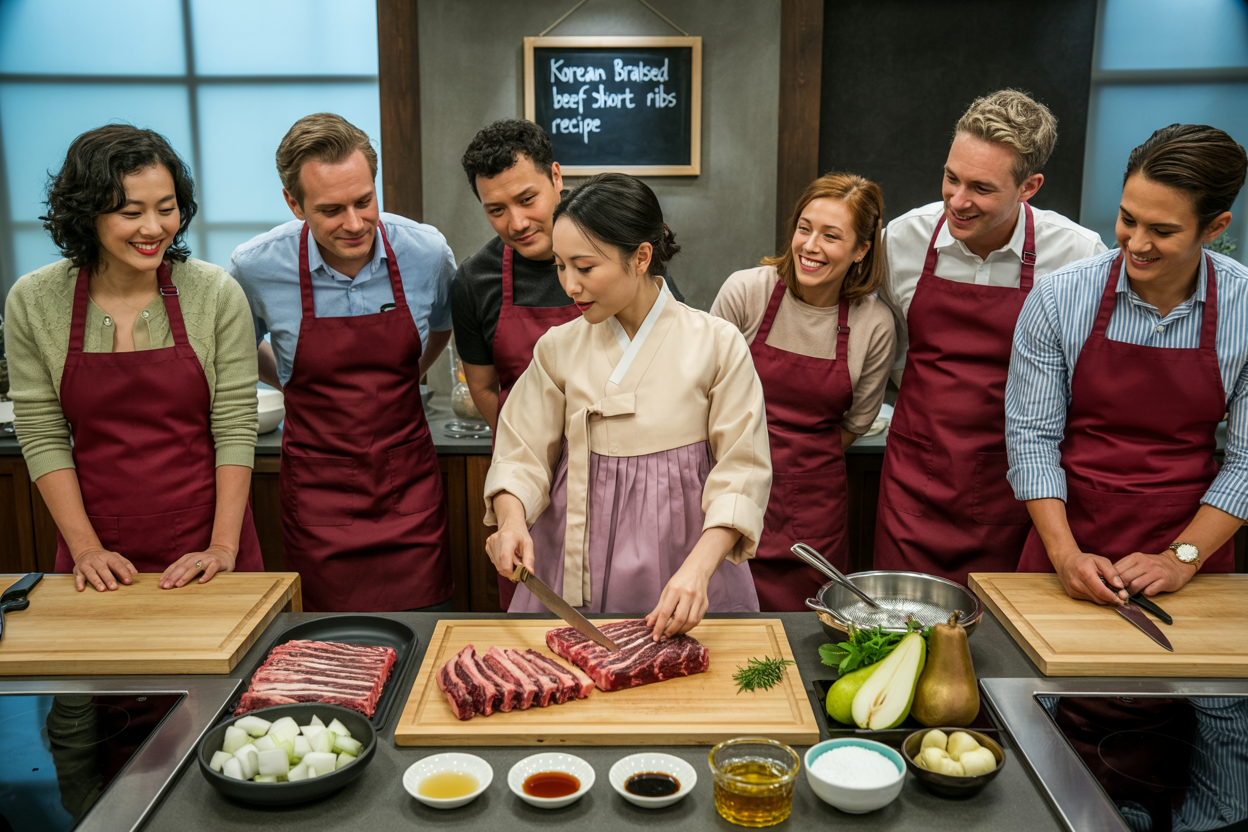
Korean Braised Beef Short Ribs honestly blew my mind the first time I tried them at a friend’s party. The meat just slid right off the bone—barely needed a knife. Galbi jjim is a classic Korean dish where beef short ribs simmer in a sweet and savory sauce until everything turns meltingly tender.
Let me be real for a second. When I first tried making galbijjim at home, I figured it’d be way out of my league. Turns out, with a couple of easy tricks and a little confidence, anyone can pull off Korean Braised Beef Short Ribs. I got hooked on tweaking the recipe, and now my friends ask for it every time we get together. Not kidding.
What’s wild about Korean Braised Beef Short Ribs is how they taste even better the next day. The flavors just hang out together in the fridge and get deeper. Serve them with rice, let the sauce soak in, and you’ll see why Korean Braised Beef Short Ribs are the star at so many family parties. Once you get the hang of galbi jjim, you’ll find yourself making it for any excuse.
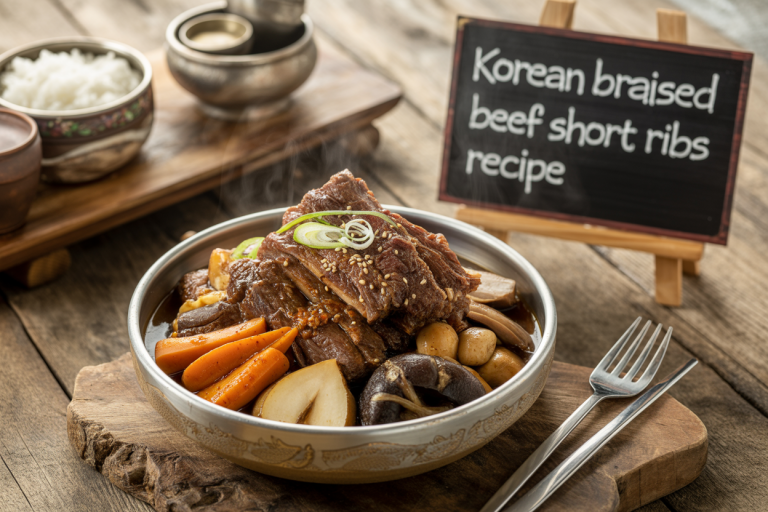
Korean Braised Beef Short Ribs Recipe
Key Takeaways
- Galbi jjim means Korean Braised Beef Short Ribs cooked until the meat falls off the bone in a sweet and savory sauce
- You just need basic braising skills, and leftovers are somehow even tastier
- Rice is a must—it soaks up every drop of that rich sauce and makes the meal complete
Storytime: The Delicious Origins of Galbi Jjim
Honestly, the first time I heard about galbi jjim, or braised short ribs, I figured it was just another fancy dish with a complicated name. But wow, I was way off.
This isn’t something you just whip up on a Tuesday. Traditional galbi jjim is a big deal at Korean celebrations—think Chuseok (Korean Thanksgiving) and Seollal (Lunar New Year).
Why save it for special days? Well, back then, meat cost a lot, so families saved their best stuff for holidays when everyone came home. Short ribs were perfect since they fed a crowd and tasted amazing.
The dish itself isn’t complicated. In Korean, galbi means ribs. Cooks would braise beef short ribs low and slow in a sauce with soy, garlic, sugar, and other goodies until the meat got soft enough to fall apart.
What makes it special:
- Super tender, almost buttery meat
- That sweet and savory sauce
- Veggies like carrots, radish, and potatoes
- Takes a while to make, but the effort shows
I love how Korean Braised Beef Short Ribs get treated like royalty. Even now, families still make Korean Braised Beef Short Ribs for holidays and big dinners. Korean markets always have a run on short ribs during those seasons because, honestly, everyone wants to make Korean Braised Beef Short Ribs for their people.
Korean Braised Beef Short Ribs bring folks together. It’s messy, a little bit of work, but completely worth it when you see everyone digging in.
Galbi Jjim Kitchen Hacks
After a bunch of trial and error, I picked up a few tricks that make prepping Korean Braised Beef Short Ribs so much easier. Trust me, I’ve botched enough batches to know.
My Braising Sauce Shortcut
Instead of measuring everything out each time, I just toss my soy sauce, garlic, mirin, brown sugar, and sesame oil into a jar the night before. Shake it up like you’re making a cocktail. The sugar dissolves better and those umami flavors come together while you sleep. Makes the next day a breeze.
The Asian Pear Secret
If you can’t find an Asian pear or Korean pear for your Korean Braised Beef Short Ribs, don’t stress. I’ve thrown in kiwi as a tenderizer and, weirdly, it works. Just… maybe don’t tell your Korean grandma.
Quick Tips That Save Time
- Get your butcher to cut the ribs smaller—your wrists will thank you
- Finish with toasted sesame oil for a flavor punch, not just regular sesame oil throughout
- Brown the ribs in batches so they actually brown and don’t steam
The Taste Test Trick
I always keep extra brown sugar and soy sauce handy when I’m finishing up. My Korean Braised Beef Short Ribs taste a bit different every time—depends on my mood, honestly. Adjusting the sweet and salty balance at the end makes all the difference.
Offbeat Spins: Unusual Takes on Galbi Jjim
I’ve seen some wild spins on Korean Braised Beef Short Ribs—sometimes I wonder if grandmas everywhere are shaking their heads. But, hey, a few of these ideas are actually genius.
Mushroom Madness
Some folks go wild with dried shiitake mushrooms in their Korean Braised Beef Short Ribs. A whole bag turns the pot into a mushroom forest. It’s earthy, and honestly, I don’t hate it, even if the beef takes a back seat.
Root Vegetable Rebellion
I’ve tried Korean Braised Beef Short Ribs with a ton of radish—sometimes daikon if I can’t find the Korean kind. One time, I thought I was eating radish stew with a side of beef. Not traditional, but it works in a pinch.
The Fancy Additions
Some cooks get creative:
- Chestnuts add a sweet, nutty crunch—surprisingly good
- Dried jujubes (dried red dates) melt into the sauce and bring a mysterious sweetness
- Ginkgo nuts—kind of odd, almost like tiny green potatoes
Kimchi Chaos
I once tossed napa cabbage kimchi right into the braising liquid for my Korean Braised Beef Short Ribs. It gave the dish a funky, spicy kick that was weirdly addictive. Some use radish kimchi for crunch and tang. My mom might never forgive me for this, but it tasted way better than expected.
Practically Immortal: Keeping Galbi Jjim Fresh
Korean Braised Beef Short Ribs last way longer than you’d expect. No superhero magic, but pretty close.
Storage in the Refrigerator
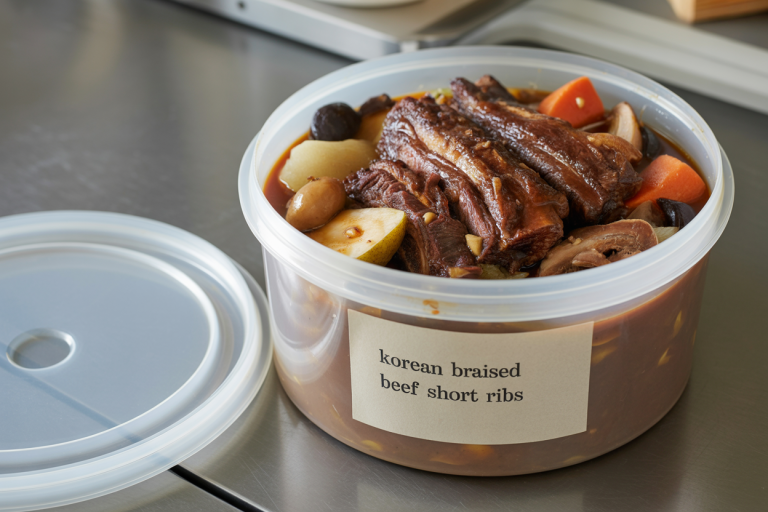
Once the ribs cool, I pack Korean Braised Beef Short Ribs into an airtight container. They stay good for about 3 to 4 days. The sauce thickens in the fridge, which makes reheating even tastier.
I make sure the meat sits under the braising liquid—that keeps everything moist and stops the beef from drying out.
Freezer Storage for the Win
You can freeze Korean Braised Beef Short Ribs for up to 3 months and they still taste awesome.
| Storage Method | Duration | Best Practice |
|---|---|---|
| Refrigerator | 3-4 days | Keep in airtight container |
| Freezer | Up to 3 months | Portion into meal-sized containers |
| Room Temperature | 2 hours max | Cool before refrigerating |
I like freezing Korean Braised Beef Short Ribs in single portions. That way, I don’t have to thaw a whole block when I just want lunch.
Reheating Tips
The stovetop method is my favorite for reheating Korean Braised Beef Short Ribs. I add a splash of water or broth to stop it from sticking, then heat on medium-low until it’s hot. The microwave works if you’re desperate, but the texture’s never quite as good.
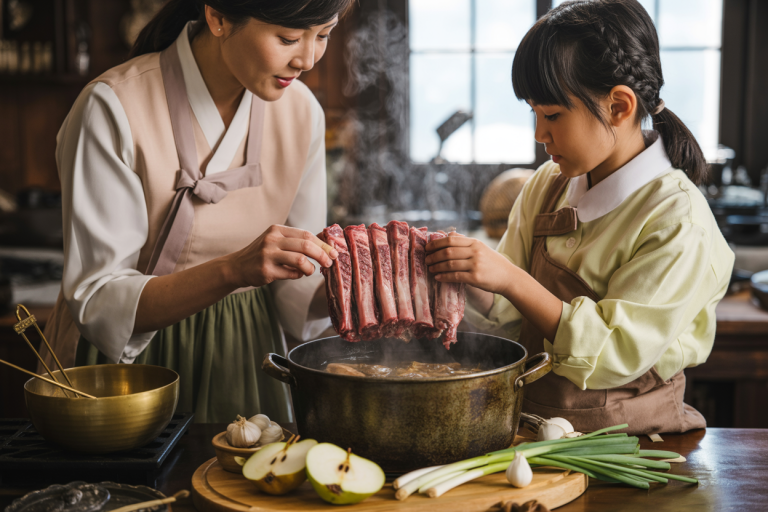
Korean Braised Beef Short Ribs Recipe – Prep
Cooking Tips For the Korean Beef Short Ribs (Galbi Jjim)
• Trim excess fat if desired to help create a cleaner finished sauce.
• Brown the ribs lightly before braising to help develop deeper flavor.
• Simmer slowly so the meat becomes tender without drying out.
• Add vegetables during the appropriate stage so they do not become overly soft.
• Skim excess fat from the surface during cooking if needed.
• Stir occasionally and gently to help keep the ingredients intact.
• Taste the sauce before serving and adjust seasoning carefully if needed.
• Let the galbi jjim rest briefly before serving so the flavors settle together.
Korean Braised Beef Short Ribs Recipe – Storage
Storage Tips For the Korean Beef Short Ribs (Galbi Jjim)
• Allow the ribs and sauce to cool slightly before placing them into storage containers.
• Store leftovers in airtight containers to help retain moisture and flavor.
• Refrigerate leftovers within 2 hours of cooking for proper food safety.
• Reheat slowly over medium-low heat for even warming.
• Add a splash of broth during reheating if the sauce thickens too much.
• Keep garnishes separate until serving time for fresher appearance.
• Freeze portions in freezer-safe containers for up to 3 months if needed.
• Leave a little space at the top of containers because sauces expand when frozen.
• Thaw frozen galbi jjim overnight in the refrigerator before reheating.
• Discard the meat or sauce if they develop a sour smell, slimy texture, discoloration, mold, or unusual taste.
Korean Beef Short Ribs (Galbi Jjim)
Ingredients
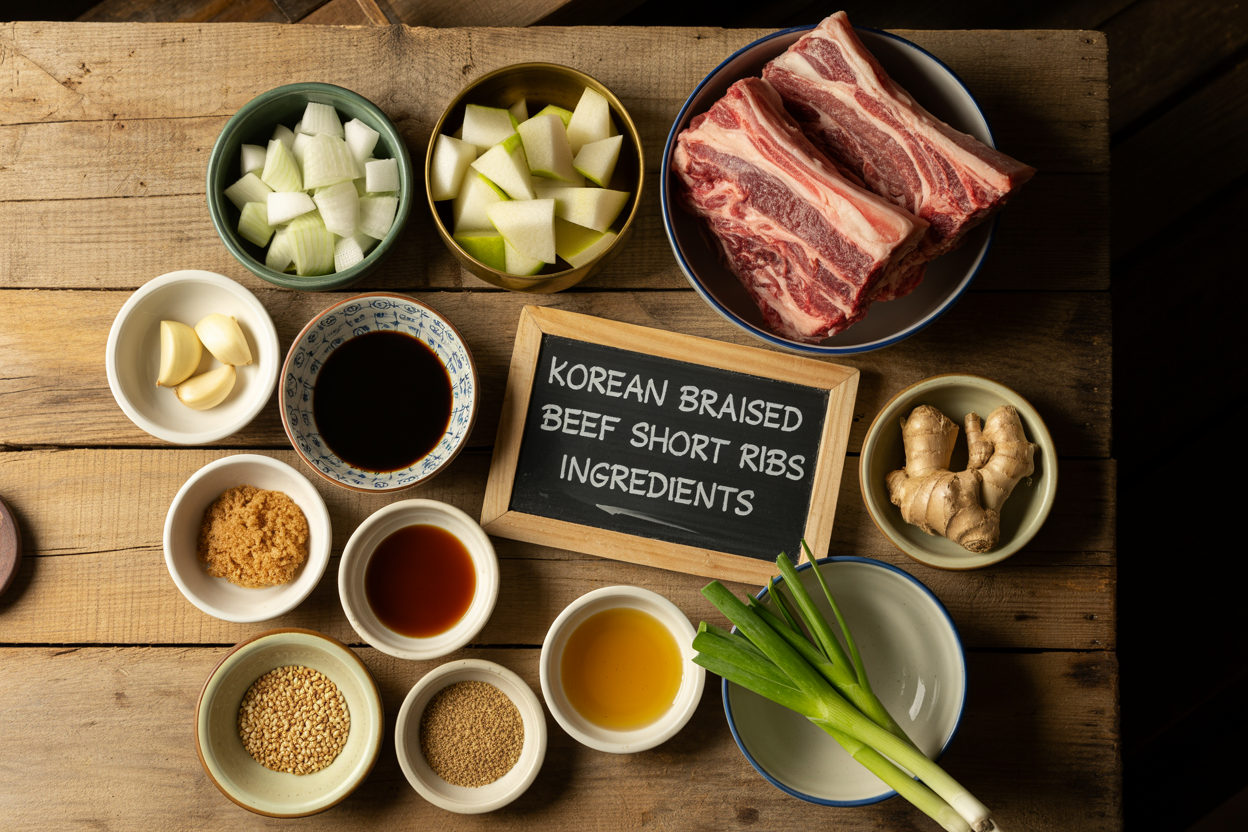
- 3 pounds beef short ribs flanken-style about 1/2-inch-thick
- 1 medium onion about 7 ounces, cut into 1-inch pieces
- 1 pear Asian, about 6 ounces, peeled and cut into 1-inch pieces
- 5 garlic cloves
- 1/2 ounce ginger fresh, peeled and cut into 1/4-inch pieces
- 1 cup soy sauce
- 1/2 cup water
- 1/4 cup brown sugar packed
- 2 tablespoons mirin
- 1 tablespoon black pepper freshly ground
- 4 scallions thinly sliced
- 2 tablespoons sesame oil toasted
- 2 tablespoons sesame seeds toasted, lightly crushed
Instructions
- Combine the onion, Asian pear, garlic, and ginger in the bowl of a food processor. Process for about 30 seconds, stopping as needed to scrape down the sides of the bowl, until a coarse purée forms. Add the soy sauce, water, brown sugar, mirin, and black pepper. Continue processing for another 15 to 30 seconds, or until the ingredients are thoroughly blended. Transfer the mixture to a medium bowl, then stir in the scallions, sesame oil, and sesame seeds.
- Place the short ribs into a gallon-sized zipper-lock bag or a large baking dish. Pour the prepared marinade over the meat and toss well so everything is evenly coated. If using a zipper-lock bag, seal it while removing as much air as possible. If using a baking dish, cover it tightly with plastic wrap. Transfer the ribs to the refrigerator and marinate for at least 1 hour or up to 24 hours.
- If using a charcoal grill, light one full chimney of charcoal. Once the coals are fully lit and covered with gray ash, pour them onto one side of the charcoal grate. Place the cooking grate over the coals, cover the grill, and preheat for 5 minutes. For a gas grill, turn half of the burners to the highest heat setting, cover the grill, and preheat for 10 minutes. Clean and lightly oil the grill grate before cooking.
- Remove the short ribs from the marinade and wipe away any excess. Arrange the ribs directly over the hot side of the grill. If cooking on a charcoal grill, leave the grill uncovered. If using a gas grill, keep the lid closed. Grill for about 5 minutes total, turning occasionally, until the beef is cooked through and lightly charred on both sides. Transfer the ribs to a serving platter and allow them to rest for at least 2 minutes before serving.
- Serve the short ribs immediately with kitchen shears available for cutting the meat from the bones into bite-sized pieces. Accompany them with lettuce and perilla leaves, steamed rice, thinly sliced garlic, chiles, scallions, assorted banchan, and samjang.
Notes
Frequently Asked Questions
Picking the right beef and knowing how to cook Korean Braised Beef Short Ribs makes all the difference. The sauce and veggie choices can totally change your results.
What cut of beef should I buy so my short ribs don’t turn into a tragic chew-fest?
I always grab bone-in beef short ribs for Korean Braised Beef Short Ribs. The bone brings flavor, and the meat stays juicy during that long braise. English-cut short ribs are my go-to—they’re thick, about 2-3 inches long, and perfect for Korean Braised Beef Short Ribs.
Korean-cut short ribs work too, but they’re thinner and cook faster. Just make sure there’s plenty of marbling; that fat melts and makes Korean Braised Beef Short Ribs extra tender.
Skip boneless short ribs if you can. They dry out faster, and honestly, you lose that awesome bone flavor in your Korean Braised Beef Short Ribs.
How do I make braised Korean-style short ribs in a slow cooker without angering the recipe gods?
Honestly, I always start my Korean Braised Beef Short Ribs by searing them in a hot pan. That deep brown crust? It’s non-negotiable. Once that’s done, I toss the short ribs into the slow cooker. Then, I pour in a mix of soy sauce, garlic, ginger, Asian pear, and rice wine over the meat. The smell at this point already makes me hungry.
I usually let my Korean Braised Beef Short Ribs cook on low for about 6 to 8 hours, until the meat just gives up and falls off the bone. If I’m adding veggies like carrots or potatoes, I wait until the last 2 hours so they don’t turn into mush. Nobody wants that mess.
The slow cooker really makes Korean Braised Beef Short Ribs juicy and tender. I try not to open the lid too much, because every time I do, I lose steam. And who wants dry ribs?
How can I make the sauce spicy enough to feel something (but not so spicy I regret my life choices)?
For a little kick, I like adding gochugaru (Korean red pepper flakes) to my savory-sweet soy sauce-based braise. Usually, 1 to 2 tablespoons gets my Korean Braised Beef Short Ribs just spicy enough. It’s warm, not painful—unless you want it that way, I guess.
Sometimes I reach for gochujang (Korean red pepper paste) if I want a deeper, more fermented heat. I’ll mix in 2 or 3 tablespoons with the braising liquid for my Korean Braised Beef Short Ribs. That flavor is hard to beat.
Fresh sliced Korean chili peppers? Sure, if I’m feeling bold. They give a sharp, clean heat. But I always remind myself: you can add more heat at the table, but you can’t take it out once it’s cooked into your Korean Braised Beef Short Ribs.
Do potatoes belong in this braise, or is that just my carb-loving heart talking?
Potatoes in Korean Braised Beef Short Ribs? Absolutely, no debate. They soak up all that sweet, savory goodness like little sponges. I can’t imagine making galbi jjim without them.
I go for Korean or Yukon gold potatoes, cut into big chunks. They join the Korean Braised Beef Short Ribs in the last hour, so they get perfectly tender but don’t fall apart. Timing is everything here.
Radish and carrots are classic too, but potatoes just hit different. My carb-loving heart is right—Korean Braised Beef Short Ribs with potatoes is pure comfort food.
Can I add cheese to the finished dish without starting an international incident?
Look, I won’t police your plate, but adding cheese to traditional Korean braised short ribs isn’t really a thing. Korean Braised Beef Short Ribs already bring so much rich, savory flavor, I just don’t see a need for dairy here.
If I’m desperate for cheese, I’d probably have it on the side, not mixed into my Korean Braised Beef Short Ribs. The soy-based sauce and cheese? They usually clash, at least for me.
There are fusion places doing wild things with Korean Braised Beef Short Ribs and cheese, so hey, maybe you’ll find something you like. But honestly, I’d give the classic version a shot before getting creative with the dairy. Korean Braised Beef Short Ribs are pretty perfect as they are.
How do I find a really good Korean short rib braise nearby when cooking feels like a personal attack?
When I’m craving Korean Braised Beef Short Ribs but can’t even imagine cooking, I start by looking up Korean restaurants that actually list galbi jjim or braised short ribs on their menu. Korean Braised Beef Short Ribs aren’t on every menu—let’s be honest, it’s a dish that takes serious time to get right.
If a place asks for advance orders for galbi jjim, that’s usually a good sign they’re making Korean Braised Beef Short Ribs fresh. I pay close attention to reviews, especially ones where people gush about the meat being super tender or falling off the bone. Who wants tough Korean Braised Beef Short Ribs? Not me.
Every now and then, Korean BBQ spots sneak Korean Braised Beef Short Ribs onto the menu as a special, separate from the usual grill-at-your-table stuff. I usually just call and ask if they’ve got Korean Braised Beef Short Ribs that day, since some places only whip it up on weekends. If you love Korean Braised Beef Short Ribs, it’s worth the extra effort to find a place that does it right. Sometimes, just thinking about those rich, savory flavors makes me want to drop everything and track down the best Korean Braised Beef Short Ribs in town.

Recipes are gathered in person and written for real-world cooking conditions.
- 10 Hungarian Dessert Recipes Passed Down Through Generations - July 25, 2026
- 11 Easy English Recipes Anyone Can Make - July 25, 2026
- Hungarian Kifli Recipe - July 25, 2026