

The Authentic Käsespätzle or German Cheese and Noodles recipe brings together soft egg noodles, melted cheese, and crispy fried onions for one of the coziest German comfort foods around. Honestly, the German Cheese and Noodles recipe from Germany’s Swabia region packs in rich, satisfying flavors that can stand up to any cheesy pasta. I’m always surprised how these homemade spätzle noodles, layered with Emmental or Gruyère and topped with caramelized onions, come together in about 45 minutes for a meal that feels both rustic and special.
This dish stands out in the world of German food because it uses humble ingredients to make something truly craveable. The German Cheese and Noodles recipe shows how you don’t need fancy tricks for a hearty meal. The noodles soak up cheese like a dream while those fried onions bring in a sweet crunch.
Cooking German Cheese and Noodles recipe at home means you get to pick your cheese blend and tweak things to your liking. I’ll walk you through making authentic German cheese noodles the old-school way, plus a few modern shortcuts for busy nights.

Cheese and Noodles Recipe (Käsespätzle)
Key Takeaways
- Käsespätzle is a classic German Cheese and Noodles recipe with soft egg noodles, gooey cheese, and caramelized onions
- This German Cheese and Noodles recipe comes from the Swabia region and usually takes about 45 minutes from start to finish
- You can get creative with the German Cheese and Noodles recipe by swapping cheeses or adding your own flair
Recipe Background and Culinary History
Käsespätzle started in Swabia, southwestern Germany, where families wanted something filling and affordable. The name mixes “Käse” (cheese) and “Spätzle” (little noodles), which pretty much sums up the German Cheese and Noodles recipe.
It’s kind of wild that such a simple German Cheese and Noodles recipe became a staple—flour, eggs, cheese, and onions were pantry basics, so families could whip it up anytime. That practicality helped it stick around.
The German Cheese and Noodles recipe holds a special spot in southern Germany and Austria, especially in Bavaria and the Swabian Alps. Every family seems to have their own twist, and I love that these German Cheese and Noodles recipes get passed down through generations.
Käsespätzle isn’t just comfort food—it’s a celebration of German traditions and sharing meals. Some folks call the German Cheese and Noodles recipe “German mac and cheese,” but honestly, the homemade noodles and layering make it way more interesting.
These days, you’ll spot the German Cheese and Noodles recipe at Oktoberfest and in Bavarian beer gardens. It’s hearty enough to be a main or a side. Melted cheese, pillowy noodles, and crispy onions—no wonder people love it far beyond Bavaria. Still, the German Cheese and Noodles recipe feels deeply rooted in southern German cooking.
Expert Preparation Tips
When I make authentic Käsespätzle, I focus on a few details. Dough consistency makes or breaks the German Cheese and Noodles recipe every time.
Getting the Dough Right
I look for a batter that’s thick but still drips slowly off the spoon. If it’s too runny, the spätzle fall apart. Too stiff, and you can’t push it through a spätzle maker. The German Cheese and Noodles recipe really depends on this step.
Cooking Techniques
I always cook the spätzle in small batches for the German Cheese and Noodles recipe. The noodles float up in about 2-3 minutes, and I scoop them out right away with a slotted spoon.
Key Tips for Success
- Keep the water at a gentle simmer for the German Cheese and Noodles recipe
- Use room temperature eggs so they mix in easier
- Always grate cheese fresh for the German Cheese and Noodles recipe—it melts better
- Layer cheese while noodles are hot
- Salt the cooking water—don’t skip this for the German Cheese and Noodles recipe
Caramelizing onions low and slow changes everything. For the German Cheese and Noodles recipe, I wait until they’re golden brown and sweet, not burnt. It takes patience, but it’s so worth it.
For any German Cheese and Noodles recipe, I prep everything before I start: cheese grated, onions sliced, flour measured. It just makes the process smoother and less stressful.

Creative Variations
I can’t help but play with the German Cheese and Noodles recipe sometimes. You can change it up to fit your mood or whatever’s in the fridge.
Cheese Options
Gruyère and Emmental are classics, but I’ll toss in sharp cheddar for a punchier German Cheese and Noodles recipe. Fontina brings extra creaminess. Sometimes I mix three or four cheeses for a super-rich German Cheese and Noodles recipe.
Add-In Ideas
To boost flavor or nutrition in my German Cheese and Noodles recipe, I’ll add:
- Crispy bacon or pancetta for smoky bites
- Sautéed mushrooms for earthiness
- Fresh spinach or kale stirred in right at the end
- Roasted garlic for a little depth
- Cherry tomatoes for some color and brightness
Topping Variations
Besides the classic fried onions, sometimes I top the German Cheese and Noodles recipe with crispy breadcrumbs or fresh herbs like parsley, chives, or thyme. Crumbled bacon works as a topping or a mix-in.
Serving Suggestions
I usually serve the German Cheese and Noodles recipe as a main, but it shines next to roasted meats too. A simple green salad cuts the richness. Some folks even add applesauce on the side—sweet and savory, why not?
If I want a lighter German Cheese and Noodles recipe, I just use a bit less cheese and more caramelized onions. The flavor holds up.
Ingredient Alternatives and Substitutions
Swapping ingredients in the German Cheese and Noodles recipe is easy. While Emmentaler and Gruyère are traditional, I often use Gouda, Swiss, or sharp cheddar if that’s what I have. The German Cheese and Noodles recipe is forgiving that way.
If I’m out of spätzle, I grab store-bought egg noodles or wide egg pasta. The texture’s a bit different, but the German Cheese and Noodles recipe still satisfies.
Common Cheese Substitutions:
- Gruyère → Swiss cheese, Comté, or Beaufort
- Emmentaler → Jarlsberg or mild Swiss
- Traditional mix → Gouda, fontina, or Monterey Jack
I use all-purpose flour for the German Cheese and Noodles recipe—no need for special German flours. The noodles turn out soft and chewy. If you need gluten-free, use a 1:1 gluten-free blend. It’s not quite the same, but it works.
Sometimes, I swap shallots for onions in the German Cheese and Noodles recipe if I want a sweeter, milder flavor. But yellow onions are my usual pick for boldness.
Butter is classic, but I use olive oil or vegetable oil in the German Cheese and Noodles recipe when needed. It’s a little less rich, but still tasty. For a lighter German Cheese and Noodles recipe, I’ll use whole milk instead of cream. It keeps things creamy without being heavy.

Cheese and Noodles Recipe (Käsespätzle) Cooking Tips
German Cheese and Noodles Recipe (Käsespätzle) Cooking Tips
• Käsespätzle is known for its tender spaetzle noodles, melted cheese, and crispy fried onions.
• Fresh homemade spaetzle provides the most authentic texture and flavor.
• The spaetzle batter should be soft enough to pass easily through a spaetzle maker or colander.
• Cook the spaetzle in gently boiling water until the noodles float to the surface.
• Drain the spaetzle well before combining with the cheese.
• Traditional cheeses include Emmental, Bergkäse, Allgäuer cheese, or other flavorful Alpine-style cheeses.
• Using a mixture of cheeses creates a richer and more complex flavor.
• Layer the hot spaetzle and cheese alternately so the cheese melts evenly.
• Keep the dish warm during assembly to ensure a creamy texture.
• Caramelized or crispy fried onions are a classic topping and add sweetness and crunch.
• Butter enhances the richness of the noodles and cheese.
• Fresh parsley or chives can add color and freshness.
• Black pepper complements the cheese without overpowering it.
• Serve immediately while the cheese is fully melted and creamy.
• The flavor should balance tender noodles, rich cheese, buttery notes, and sweet onions.
• Käsespätzle is one of southern Germany’s most beloved comfort foods, especially in Bavaria and the Allgäu region.
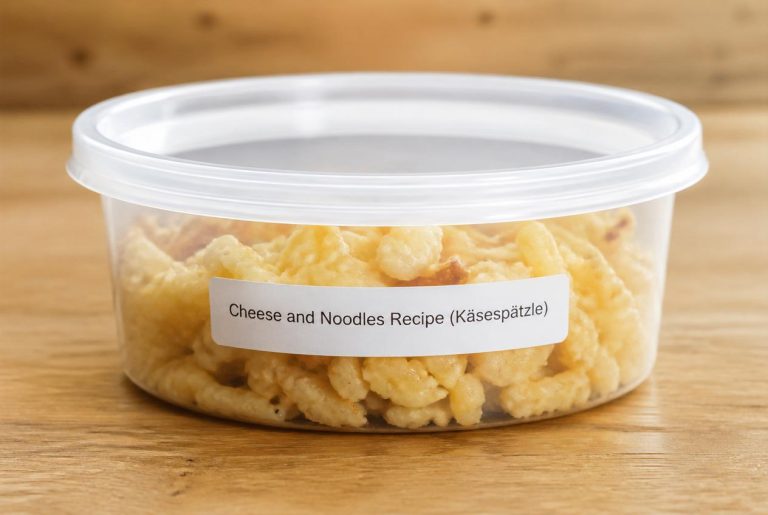
Cheese and Noodles Recipe (Käsespätzle) Storage Tips
German Cheese and Noodles Recipe (Käsespätzle) Storage Tips
• Allow the dish to cool before transferring it into storage containers.
• Store refrigerated in airtight containers to preserve freshness.
• Refrigeration may cause the cheese sauce to firm, which is normal.
• Reheat gently over low heat or in the oven until thoroughly warmed through.
• Add a small splash of milk or cream during reheating if the noodles seem dry.
• Cheese and onion flavors often deepen after overnight refrigeration.
• Store crispy onion toppings separately whenever possible to preserve texture.
• Freeze portions in airtight freezer-safe containers if desired.
• Defrost frozen portions gradually in the refrigerator before reheating.
• Stir gently during reheating to distribute the melted cheese evenly.
• Use clean utensils when handling leftovers to help maintain freshness.
• Cheese-and-pasta dishes are generally best enjoyed within a shorter refrigerated storage period for ideal quality and safety.
• Keep away from strongly scented foods because cheese readily absorbs odors.
• Slight thickening of the cheese during storage is normal.
• Discard leftovers if the cheese, noodles, or onions develop sour odors, mold, slime, or unusual discoloration.

German Cheese and Noodles Recipe (Käsespätzle)
Ingredients
- 1 ½ cups all-purpose flour
- ¾ teaspoon ground nutmeg
- ¾ teaspoon salt
- ⅛ teaspoon pepper
- 3 large eggs
- ⅜ cup 2% milk
- 3 tablespoons butter
- 1 ½ cups shredded Emmentaler cheese
- 1 onion sliced
Instructions
- Begin by gathering and measuring all of your ingredients so everything is ready before mixing. In a large mixing bowl, sift together the flour, nutmeg, salt, and black pepper. Sifting helps eliminate lumps and evenly distributes the seasonings throughout the batter.
- In a separate medium bowl, beat the eggs until smooth. Gradually add the milk and flour mixture in alternating additions, whisking continuously until a smooth batter forms. The finished batter should be thick but still soft enough to pass through a spaetzle maker or press.
- Once mixed, allow the batter to rest for 30 minutes at room temperature. This resting period hydrates the flour and relaxes the gluten, resulting in more tender spaetzle with a better texture.
- Bring a large pot of lightly salted water to a gentle boil. Working in batches if necessary, press the batter through a spaetzle press, spaetzle maker, or colander directly into the boiling water. The batter will form small dumpling-like noodles as it drops into the water.
- Allow the spaetzle to cook until they float to the surface. This usually takes only a few minutes. Floating indicates that the dumplings are cooked through and ready to be removed.
- Using a slotted spoon or spider strainer, transfer the cooked spaetzle to a large serving bowl. Continue cooking the remaining batter until all of the spaetzle are prepared.
- While the spaetzle are still hot, add 1 cup of the cheese and stir gently until the cheese begins to melt and coat the noodles. The residual heat from the freshly cooked spaetzle will help create a rich, creamy texture.
- Mix carefully to ensure the cheese is evenly distributed throughout the bowl.
- In a large skillet, melt the butter over medium-high heat. Add the sliced or chopped onion and cook, stirring occasionally, until the onions become soft, golden brown, and lightly caramelized.
- This process develops sweetness and depth of flavor that perfectly complements the rich cheese and tender spaetzle. Continue cooking until the onions are deeply golden but not burned.
- Add the cooked spaetzle to the skillet with the onions. Sprinkle in the remaining ½ cup cheese and stir gently until everything is thoroughly combined and the cheese has melted completely.
- The finished dish should be creamy and cheesy, with the golden onions distributed throughout. The cheese should coat the spaetzle while remaining slightly stretchy and rich.
- Remove the skillet from the heat and serve the Käsespätzle immediately while hot. For an authentic presentation, garnish with additional caramelized onions, freshly cracked black pepper, or chopped parsley if desired.
- This classic German comfort dish is often compared to macaroni and cheese but has a richer, heartier character thanks to the homemade spaetzle and caramelized onions. It can be served as a main course alongside a green salad or as a side dish with roasted meats, schnitzel, or sausages.
German Cheese and Noodles Recipe (Käsespätzle) Frequently Asked Questions
People ask a lot about the German Cheese and Noodles recipe—pronunciation, ingredients, how to prep and store it. Here’s what I usually tell them.
What is Käsespätzle made of?
The German Cheese and Noodles recipe uses three main things: spätzle noodles, melted cheese, and caramelized onions. The spätzle are soft egg noodles made from flour, eggs, water, and salt. That’s really all you need for a good German Cheese and Noodles recipe.
I always layer the cheese with the hot noodles to get that creamy, gooey German Cheese and Noodles recipe. Crispy onions on top make all the difference.
How do you pronounce Käsespätzle correctly?
I say Käsespätzle like “KAY-zuh-shpets-luh.” “Käse” means cheese and sounds like “KAY-zuh.” “Spätzle” is “SHPETS-luh”—soft “sh” at the start. Both “ä”s sound like “ay” in “say.” The German Cheese and Noodles recipe just sounds fun, doesn’t it?
What ingredients do you need to make homemade spätzle dough?
I use four basics for the German Cheese and Noodles recipe: all-purpose flour, eggs, water or milk, and salt. The usual ratio is about 2 cups flour to 3 or 4 eggs. I add enough water or milk to make a thick, sticky batter—think thicker than pancake batter, but not stiff. That’s the secret to a great German Cheese and Noodles recipe.
Some recipes add a pinch of nutmeg. I sometimes do, sometimes don’t—it’s up to you. The dough should look smooth and just a little elastic when mixed for the best German Cheese and Noodles recipe.
Which cheeses work best for authentic Käsespätzle?
If you ask me, I always reach for Alpine-style cheeses that melt well when I want a truly authentic German Cheese and Noodles recipe. Emmental, Gruyère, and Appenzeller are the classics—they melt into this creamy, dreamy layer that just makes the whole dish sing. I mean, who doesn’t want creamy noodles?
When I can get my hands on German mountain cheese or Bergkäse, I don’t hesitate. That stuff is gold for any German Cheese and Noodles recipe. Usually, I’ll mix two or three cheeses together, because honestly, why settle for one flavor when you can have a whole orchestra?
The real trick is to pick cheeses with good melting properties and rich, nutty flavors. I steer clear of pre-shredded cheese for my German Cheese and Noodles recipe. Those weird additives just ruin the melt, and nobody wants that. You want that gooey, stringy cheese pull, right?
How do you make Käsespätzle step by step at home?
So, for my go-to German Cheese and Noodles recipe, I start by mixing up the spätzle dough. I let it rest for about 15 to 30 minutes—maybe longer if I get distracted. After that, I grab a large pot of salted water and get it boiling. It’s almost meditative, waiting for that rolling boil.
Next, I press the dough through a spätzle maker (or sometimes just a colander, because who always has the right tool handy?) straight into the boiling water. The noodles are ready when they float to the top—usually just a couple of minutes. I scoop them out, trying not to burn myself, and move fast so they stay hot for the German Cheese and Noodles recipe.
Right away, I layer the steaming spätzle in a baking dish with plenty of shredded cheese. I keep layering spätzle and cheese until I’ve used everything up. The heat from the noodles starts melting the cheese instantly, and the smell is honestly irresistible. That’s the heart of a good German Cheese and Noodles recipe—those layers of cheesy goodness.
While the cheese is melting into the noodles, I fry up a bunch of sliced onions in butter. I like them golden and a little bit crispy—maybe even a touch overdone for extra flavor. Just before serving, I pile those onions on top of the cheesy noodles. It’s the finishing touch for any German Cheese and Noodles recipe, and honestly, it’s what makes the whole thing unforgettable.
How can you store and reheat Käsespätzle without it drying out?
So, let’s talk about storing that Käsespätzle. I usually toss leftover German Cheese and Noodles recipe into an airtight container, then stick it in the fridge. You can keep the German Cheese and Noodles recipe fresh for about three days—though, honestly, it rarely lasts that long at my place. Before reheating, I splash in a bit of milk or cream. It just helps the German Cheese and Noodles recipe stay creamy instead of turning into a block of cheese and noodles (which, nobody wants).
When it’s time to reheat, I go for a skillet over medium heat. I drop in a little butter, then add the German Cheese and Noodles recipe. Stir gently—don’t go wild, or you’ll break up all those lovely cheesy bits. The German Cheese and Noodles recipe warms up nicely this way, and you keep that texture that makes the German Cheese and Noodles recipe so good. Microwaves? Sure, they’re fast, but the German Cheese and Noodles recipe can dry out if you’re not careful.
If you must use the microwave, cover the German Cheese and Noodles recipe, pour in a tablespoon of milk or water, and zap it in short 30-second bursts. Stir halfway through. I’ve found this helps the German Cheese and Noodles recipe stay moist, but honestly, the skillet wins every time. There’s just something about the German Cheese and Noodles recipe getting a little buttery on the bottom that makes it irresistible. If you love the German Cheese and Noodles recipe as much as I do, you’ll want to treat those leftovers right. And yes, I said German Cheese and Noodles recipe a lot… but hey, it’s worth repeating when something’s this tasty.

Recipes are gathered in person and written for real-world cooking conditions.
- 10 Hungarian Dessert Recipes Passed Down Through Generations - July 25, 2026
- 11 Easy English Recipes Anyone Can Make - July 25, 2026
- Hungarian Kifli Recipe - July 25, 2026