
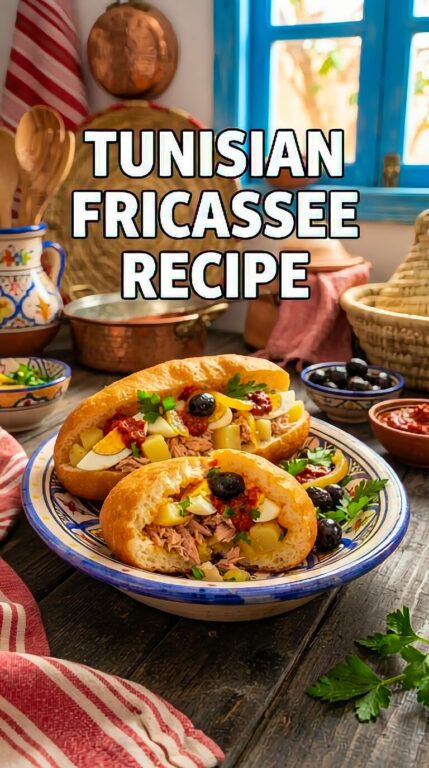
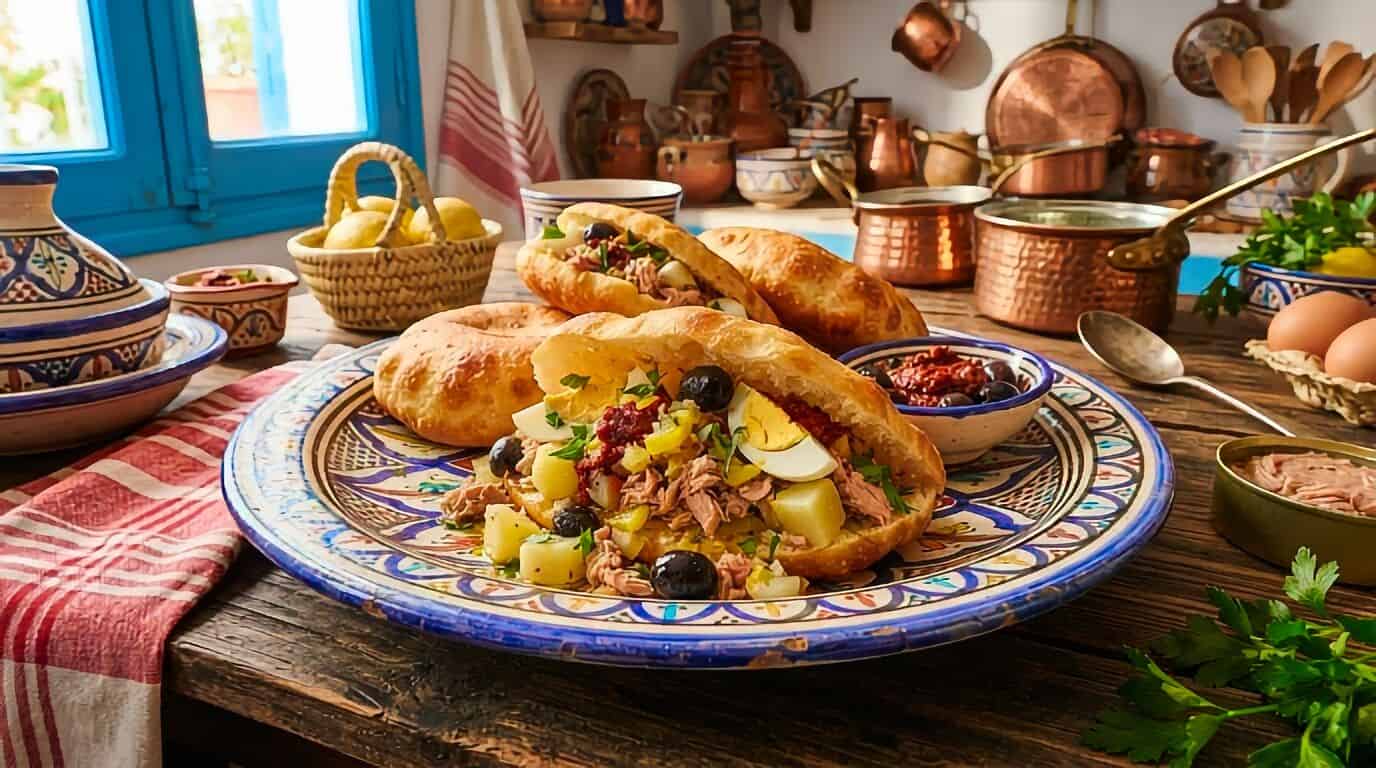
Would you like a Tunisian Fricassee recipe, you can whip one up at home with just a handful of pantry staples. Picture this: a light, golden fried bun, split open and stuffed with tuna, harissa, boiled egg, cooked potatoes, black olives, and some sharp preserved (citron beldi) or pickled lemon. That combo? It gives you a crisp, airy roll that hits all the notes—heat, brine, tang. It’s exactly what you want from a legit Tunisian Fricassee recipe.
Honestly, digging into a Tunisian Fricassee recipe means uncovering its roots, figuring out how a spoonful of slata méchouia or tomato sauce can really brighten the filling, and why russet potatoes and a well-boiled egg just work for the texture. I’ve picked up a few tricks along the way: nailing the dough, keeping the frying temp just right, and layering harissa with preserved lemon so every bite pops. There’s a method to the madness, but honestly, it’s mostly about a little practice and a lot of tasting.
History and Description
Look, you’ll spot the Tunisian Fricassee recipe on just about every list of Tunisia’s classic street foods. It’s a small, fried yeast roll packed with savory fillings. This sandwich started out as a grab-and-go meal for workers in Tunis’s medina, but pretty quickly, it spread everywhere. Now, you’ll see it at parties, on street corners, in people’s hands—no surprise there.
Don’t confuse it with the French “fricassée.” The Tunisian Fricassee recipe is all about a fried bun stuffed to the brim with tuna, hard-boiled egg, olives, preserved lemon, harissa, capers, and, yeah, usually some mashed potato. The outside is crisp, the inside’s airy, and the whole thing is ridiculously portable. It’s the kind of sandwich you grab when you want something real and satisfying.
Stories passed down and a few food writers say the Tunisian Fricassee recipe took off in the 19th and 20th centuries, when cooks and vendors started tossing together whatever they had on hand. You’ll spot Jewish, Italian, and French touches in both the ingredients and the name—Tunisia’s food scene is a real mix, and this sandwich proves it.
Here’s the thing: the Tunisian Fricassee recipe isn’t set in stone. Every vendor, every home cook, puts their own spin on the fillings and spice. Some go heavy on harissa, others keep it mild. Either way, it’s always cheap, big on flavor, and made for sharing or scarfing down fast. In my opinion, that’s what makes it so iconic.
If you want to geek out on the details or brush up on the cultural backstory, check out this Fricasse – Wikipedia entry. It’s got a solid rundown of what makes the Tunisian Fricassee recipe stand out.
Cooking Tips
If you’re planning to make a Tunisian Fricassee recipe, get your dough and fillings ready ahead of time so you can fry up fresh rolls without feeling rushed. It helps a lot to chill boiled potatoes and eggs before you start assembling—makes them easier to handle, and it keeps the fillings from steaming the fried bread. Nobody wants soggy bread, right?
Pick a neutral oil with a high smoke point for deep frying. You want the outside crisp, not oily, and you really don’t want the oil’s flavor to take over. Keep the oil temperature steady, somewhere between 350–375°F (175–190°C). That way, your Tunisian Fricassee recipe turns out golden and the inside stays nice and airy. If you’re not sure about the temp, a cheap thermometer saves a lot of guesswork.
Tunisian Fricassee Sandwich Recipe
Ingredients
- 15 baugettes or hot dog buns
- 1 tbsp olive oil extra-virgin
- 1 1/2 all-purpose flour white
- 2 1/2 tbsps dry yeast active
- 3/4 cup olives pitted Kalamata
- 3 potatoes Russet
- 8 eggs
- 15 slices swiss cheese
- 12 oz. harissa 1 can
- 2 cans tuna drained
- 1 bunch parsley
- 1 pinch salt
Equipment
- Baking sheet
- mixing bowl
- Bowl for Harissa Tuna Mixture
- Utensils for Spreading and Mixing
- Oven or Grill
Instructions
- a. Slice the baguettes or hot dog buns lengthwise, but not all the way through.
- b. Lightly brush the cut sides with extra-virgin olive oil.
- c. Toast the bread in an oven or on a grill until slightly crispy.
- a. In a mixing bowl, combine white all-purpose flour and active dry yeast.
- b. Gradually add warm water while kneading to form a smooth dough.
- c. Let the dough rise in a warm place until it doubles in size.
- a. Pit the Kalamata olives and slice them.
- b. Peel and thinly slice the Russet potatoes.
- c. Beat the eggs and season with a pinch of salt.
- a. Roll out the risen dough into a rectangular shape.
- b. Layer the sliced Swiss cheese, sliced olives, and sliced potatoes over the dough.
- c. Pour the beaten eggs evenly over the layers.
- d. Carefully roll up the dough with the filling like a jelly roll.
- a. Place the rolled dough on a baking sheet.
- b. Bake in a preheated oven according to the dough's packaging instructions until the dough is golden brown and the filling is cooked through.
- a. In a bowl, mix the harissa paste with drained tuna.
- b. Chop the parsley finely and add it to the tuna mixture.
- c. Combine everything well to create a flavorful filling.
- a. Once the baked fricassee is slightly cooled, slice it into individual portions.
- b. Open each portion and spread a generous amount of the harissa tuna mixture.
- a. Arrange the sandwiches on serving plates.
- b. These sandwiches can be served warm or at room temperature, depending on your preference.
Notes
After frying, toss the rolls onto paper towels for a minute, then move them to a wire rack if you’re after that extra crunch. Don’t cram too many into the fryer at once—if you do, the oil cools down fast, and you’ll end up with greasy rolls. Trust me, I’ve learned that the hard way with a Tunisian Fricassee recipe.
Want a little fruitiness? Try brushing the finished rolls with a bit of good olive oil. If you’re after a stronger olive flavor in the filling, mix in a tiny drizzle of extra virgin olive oil with your tuna or potato. Go easy, though; too much oil and you’ll just get mush. A Tunisian Fricassee recipe shines when the fillings are balanced.
Keep those fillings dry—mash your potatoes well, and pat the tuna with a paper towel to get rid of extra liquid. Wet fillings will just ruin the texture of your fried bread, and your Tunisian Fricassee recipe won’t keep as long. Not ideal if you’re hoping for leftovers.
For safety, keep an eye on the oil with a thermometer and use a splatter screen or long-handled tools. Hot oil’s no joke. When you’re done, let the oil cool down, then strain and store it if you want to reuse it. Otherwise, toss it properly. It’s all part of mastering the Tunisian Fricassee recipe.
Honestly, once you get the hang of these steps, making a Tunisian Fricassee recipe feels way less intimidating. It’s worth the little bit of extra prep and care. And hey, if you mess up the first time, just try again—the results are so good, you’ll want to perfect your Tunisian Fricassee recipe anyway.
There’s something pretty special about nailing a Tunisian Fricassee recipe at home. The crispy bread, the savory fillings… it’s a crowd-pleaser, no matter the occasion. Just remember these tips, and you’ll be on your way to a killer Tunisian Fricassee recipe before you know it.

Recipes are gathered in person and written for real-world cooking conditions.
- 10 Hungarian Dessert Recipes Passed Down Through Generations - July 25, 2026
- 11 Easy English Recipes Anyone Can Make - July 25, 2026
- Hungarian Kifli Recipe - July 25, 2026