
You’ll find Peruvian tres leches cake both comforting and surprisingly simple to master, blending a light sponge with a rich soak of three milks that keeps every slice moist without feeling heavy. This recipe gives you a classic tres leches texture and flavor while walking you through techniques and common questions so you can bake it confidently at home.
As you explore origins and background, you’ll learn what makes the Peruvian version distinct and which steps matter most for soak level and crumb. Expect clear, practical tips on preparation, timing, and common troubleshooting so your cake turns out reliably delicious every time.
Origins and Cultural Context
You’ll find tres leches cake firmly rooted in Latin American dessert traditions that favor soaked sponge cakes and rich dairy flavors. The technique of soaking a light cake in a combination of condensed milk, evaporated milk, and cream reflects culinary exchanges brought by European colonization, where soaked cakes existed in countries like Spain and Italy.
When you make or taste Peruvian tres leches, you’re participating in a broader regional practice that adapts local ingredients and preferences. Different countries emphasize varying textures and toppings; for a Peruvian version, people often aim for a balanced sweetness and a slightly denser, custard-like soak.
You should note how industrial ingredients shaped the recipe’s spread. The global availability of condensed and evaporated milk in the late 19th and early 20th centuries helped the dessert become widely accessible, transforming home baking across Latin America. This shift appears in historical overviews that trace soaked-cake traditions and the modern tres leches evolution.
You may encounter variations that reflect local culture—some bakers add citrus zest, coffee, or regional spirits, while others keep it simple with whipped meringue or fresh fruit. If you want context beyond Peru, read more about the cake’s debated origins and cultural journey in detailed accounts of the dessert’s history.
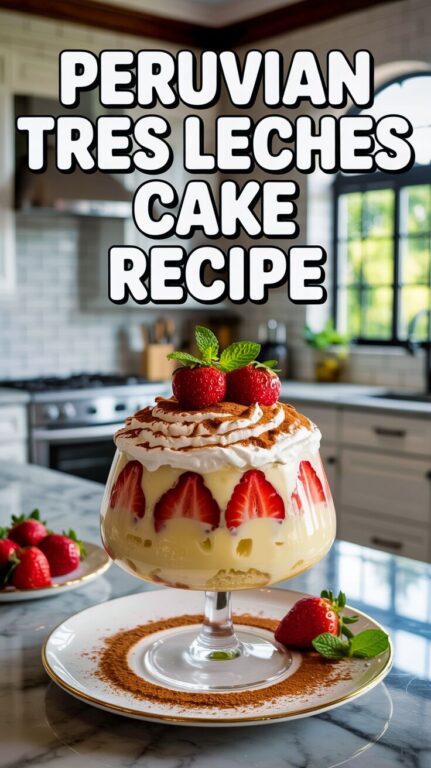
Recipe Details and Background
You’ll find Peruvian tres leches cake begins with a light sponge that relies on well-separated eggs and gently beaten egg whites for lift. The yolks add richness and color while the whites create an airy structure, so handle them carefully to keep the batter tender.
This cake uses a modest amount of baking powder or none at all depending on the sponge style you choose; many traditional recipes depend primarily on whipped eggs rather than chemical leaveners. If you use baking powder, add it sparingly to avoid a coarse crumb.
The defining step is the three-milk soak: evaporated milk, sweetened condensed milk, and whole milk (or cream) pour into the baked sponge to saturate it. Pour slowly and evenly so the cake soaks without collapsing, then chill the cake several hours for best texture.
Your topping often balances the sweetness of the soak. Whipped cream or a light meringue works well; meringue gives a glossy finish while whipped cream keeps the cake soft and simple. For a practical guide and measurements for a classic Peruvian version, consult a detailed Peruvian Tres Leches Cake Recipe.
If you follow these points—careful egg handling, optional baking powder restraint, thorough soaking, and an appropriate topping—you’ll get a moist, balanced tres leches cake that holds true to tradition.
Techniques and Preparation Advice
Start by making a light sponge cake that will absorb the milk mixture without collapsing. Whisk egg whites to stiff peaks and fold them gently into the batter with a rubber spatula to keep the cake airy.
Bake until the sponge springs back and a skewer comes out clean; avoid overbaking because a dry cake won’t soak properly. Once cooled slightly, poke the top evenly so the soaked cake accepts the milk mix.
When you combine the three milks, chill the mixture first so it’s cold when you pour it over the warm cake. Pour slowly and evenly, letting the liquid sink in; you can rest the pan in the refrigerator for several hours or overnight for best results.
For meringue or whipped topping, use fresh egg whites and whip to stiff peaks if you make Italian or Swiss meringue. If you use whipped cream instead, chill the bowl and beaters first to achieve stable peaks without over-whipping.
Use a rubber spatula to fold and to spread toppings; it preserves air in the sponge and prevents deflating. Trim edges only if necessary; a uniform surface soaks more evenly than an irregular one.
Monitor texture as the cake soaks: it should be deeply moist but not waterlogged. If parts are soggy, adjust by reducing soak volume next time or bake a touch longer for a firmer crumb.
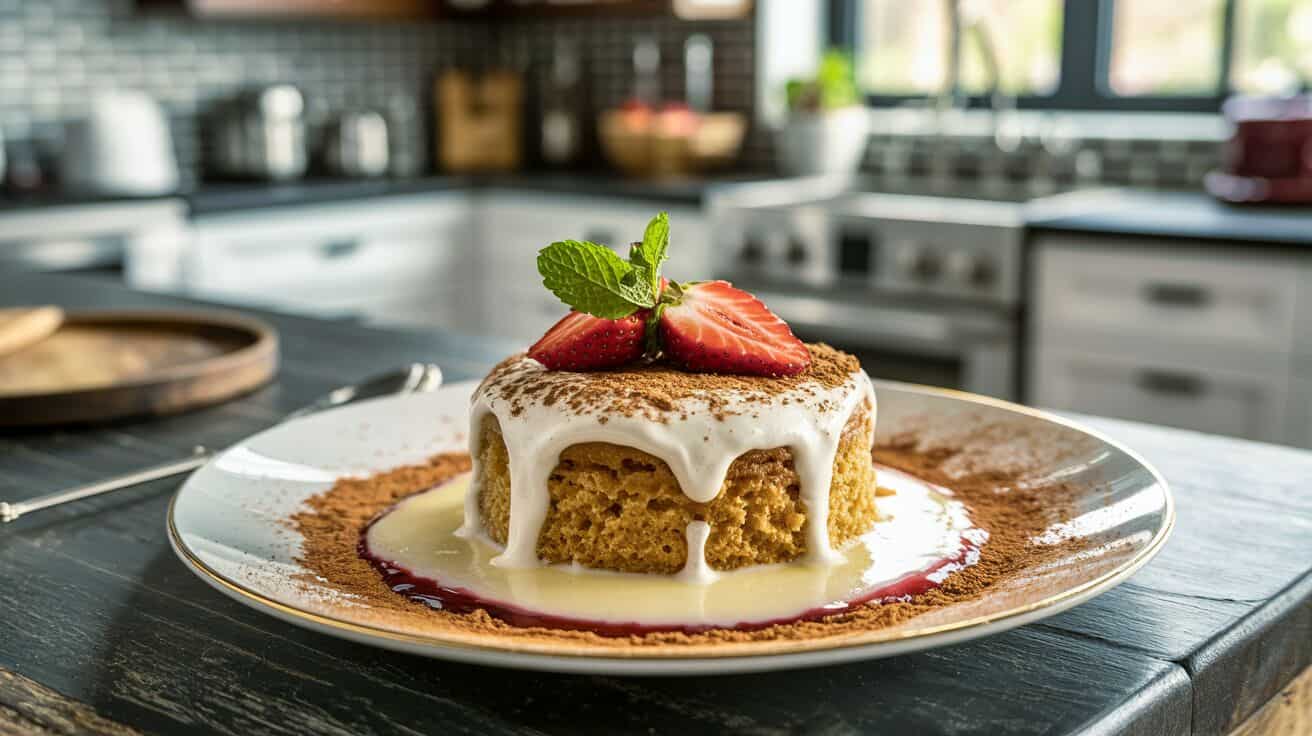
Peruvian Tres Leches Cake Recipe: Authentic Step-by-Step Guide for Moist, Creamy Results
Ingredients
- 3/4 cup sugar
- 1 teaspoon vanilla extract
- 1 cup flour wheat
- 1/2 cup milk
- 1 teaspoon baking powder
- 1 cup condensed milk
- 1 cup evaporated milk
- 1 cup whipping cream
- 3/4 cup sugar
- 1/4 cup water just enough to cover the sugar
- 2 teaspoon cinnamon powder
Instructions
- Preheat the oven to 300°F (150°C).
- Grease a glass baking dish with butter and lightly dust it with flour, coating the bottom and sides evenly.
- Make the Cake Batter
- In the bowl, a stand mixer, combine the egg yolks, milk, and vanilla extract.
- Beat on high speed for about 2 minutes.
- Gradually add the sugar while continuing to mix.
- Add the sifted flour and baking powder, mixing until a smooth batter forms.
- In a separate bowl, beat the egg whites until they are almost at stiff peaks.
- Gently fold the beaten egg whites into the batter using a whisk.
- Mix just until incorporated, taking care not to overwork the batter so it remains light and airy.
- Pour the batter into the prepared baking dish and spread it evenly.
- Bake for approximately 20 minutes, or until the top is lightly golden and a toothpick inserted into the center comes out clean.
- Remove the cake from the oven and allow it to cool completely in the baking dish.
- Once the cake has cooled, leave it in the baking dish.
- Using a straw or skewer, poke holes evenly across the entire surface, the cake.
- This allows the milk mixture to soak into every part, the sponge.
- Combine the evaporated milk, whipping cream, and condensed milk in a blender.
- Blend until the mixture is smooth and thoroughly combined.
- Slowly pour the milk mixture evenly over the cooled cake, allowing it to soak into the sponge.
- Cover and refrigerate for 6 to 8 hours, or until the cake has absorbed the liquid.
- Place the sugar and enough water to just cover it into a saucepan.
- Heat over medium heat until a syrup forms.
- Meanwhile, beat the egg whites until stiff peaks form.
- With the mixer running, slowly drizzle the hot syrup into the egg whites in a thin, steady stream.
- Continue beating until the meringue is glossy, thick, and fully cooled.
- Remove the chilled cake from the refrigerator.
- Transfer the meringue to a pastry bag and pipe decorative peaks over the top, the cake.
- Finish by sprinkling the surface lightly with ground cinnamon.
- Serve

Recipes are gathered in person and written for real-world cooking conditions.
- 10 Hungarian Dessert Recipes Passed Down Through Generations - July 25, 2026
- 11 Easy English Recipes Anyone Can Make - July 25, 2026
- Hungarian Kifli Recipe - July 25, 2026