
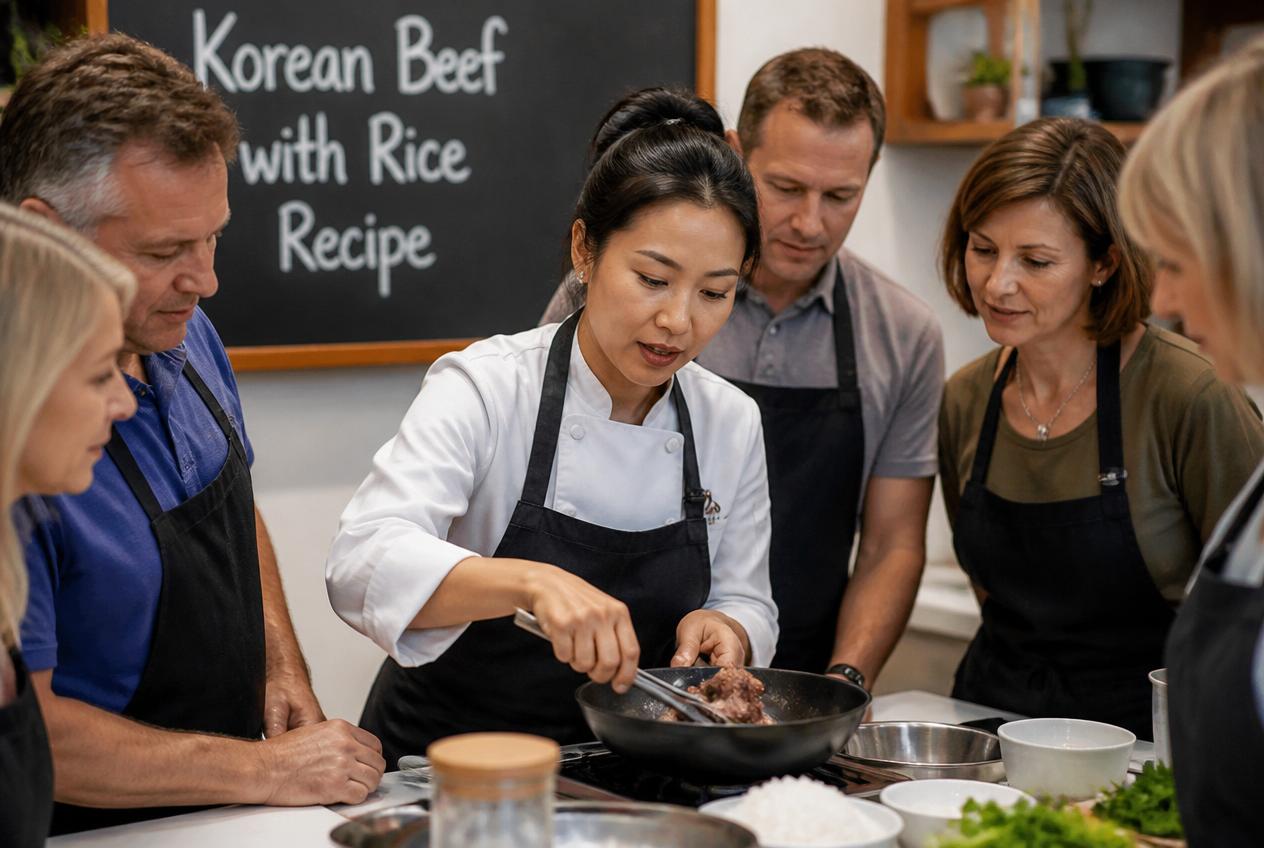
Honestly, the first time I tried Korean Beef with Rice or jangjorim, I never guessed a simple dish of soy-braised beef could totally change how I felt about meal prep. Jangjorim is a Korean soy-braised beef side dish that’s salty, a little sweet, and so loaded with flavor that just a small piece can make a bowl of rice taste incredible. It’s the sort of dish that just chills in your fridge, quietly waiting to turn a boring lunch into something you actually crave. Korean Beef with Rice is just that kind of magic.
The real genius of this traditional Korean banchan is that it somehow gets better as it sits. The beef soaks up all that garlicky, peppery soy sauce, turning super tender and umami-packed. I’ve caught myself sneaking bites straight from the fridge at midnight, which probably says more about me than the dish, but hey, Korean Beef with Rice is that good.
What makes jangjorim even better? It’s forgiving. Toss in eggs, peppers, or just keep it simple with beef. It keeps well, reheats perfectly, and really does all the work when you want something tasty but don’t feel like cooking much. Korean Beef with Rice has definitely made my rice happier.
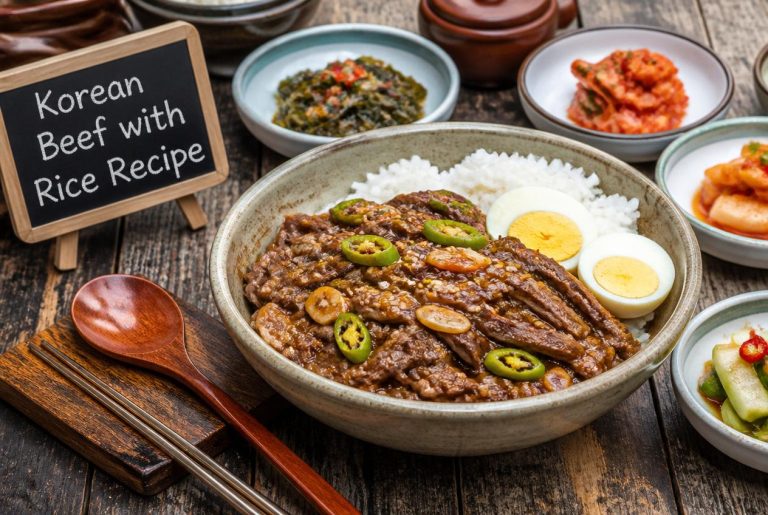
Korean Beef with Rice Recipe
Key Takeaways
- Jangjorim is a savory Korean braised beef dish that’s perfect for meal prep and gets more flavorful over time
- The dish uses simple ingredients like beef, soy sauce, and garlic but delivers big, umami-rich flavor
- You can customize jangjorim with eggs and peppers, and it stores well in the fridge for quick meals throughout the week
How Did Jangjorim End Up on Your Plate? (A Brief Description)
Let me tell you how this delicious Korean soy-braised beef landed on my dinner table. I didn’t just wake up and think, “Hey, I need some soy sauce braised beef in my life.” Korean Beef with Rice kind of found me.
Jangjorim is a traditional Korean side dish in the jorim category, which just means “simmered dishes” in Korean. It’s basically beef that decided to soak in soy sauce for a while and came out transformed.
There are two stages to the magic. First, you boil the beef with aromatics like garlic, onion, and ginger. Then you simmer it in a mix of soy sauce, sugar, and rice wine until it’s crazy tender. Korean Beef with Rice really is all about that slow, flavorful bath.
What makes jangjorim special as banchan:
- It’s a mitbanchan (essential side dish) in Korean food
- Stays fresh in the fridge for days
- Perfect for quick meals with rice
- Often includes hard-boiled eggs and peppers
I found out that this savory Korean side dish is one of those rare Korean Beef with Rice recipes that makes meal prep genuinely enjoyable. Cook it once, and you’ve got protein-packed banchan for days.
The best part? Jangjorim is packed in lunch boxes all over South Korea and even sold at convenience stores. So yeah, I’m eating what Korean kids bring to school, but as an adult, nobody’s judging me. Korean Beef with Rice is just good food, no matter your age.
Pro Tips for Beefy Brilliance
Choosing the right soy sauce makes a big difference in Korean soy-braised beef. Regular soy sauce is fine, but if you want a deeper, more delicate flavor, reach for soup soy sauce. Korean Beef with Rice really shines when you get this part right.
My secret? A splash of mirin (or mirim, same thing) adds sweetness without dumping in sugar. It balances the salty braising liquid really well.
Here’s what I always do to level up my Korean Beef with Rice:
- Cut beef against the grain after cooking so it stays tender and doesn’t get chewy
- Skim the foam from the braising liquid in the first 10 minutes for a cleaner-tasting sauce
- Save that braising liquid—it’s pure gold for drizzling over your rice later
- Add quail eggs during the last 20 minutes so they soak up all that flavor
I like using beef brisket or chuck because they get super tender during the long simmer. Don’t rush it. Low and slow is the way to go with Korean Beef with Rice.
If I want extra flavor, I toss in a few smashed garlic cloves and a chunk of ginger. The kitchen smells amazing, and honestly, Korean Beef with Rice is worth making just for that aroma.
The best thing about this Korean side dish is how much better it tastes after a night in the fridge. The beef and eggs soak up even more flavor, turning into little flavor bombs. I always make a big batch of Korean Beef with Rice because my family can’t resist midnight raids on the container.
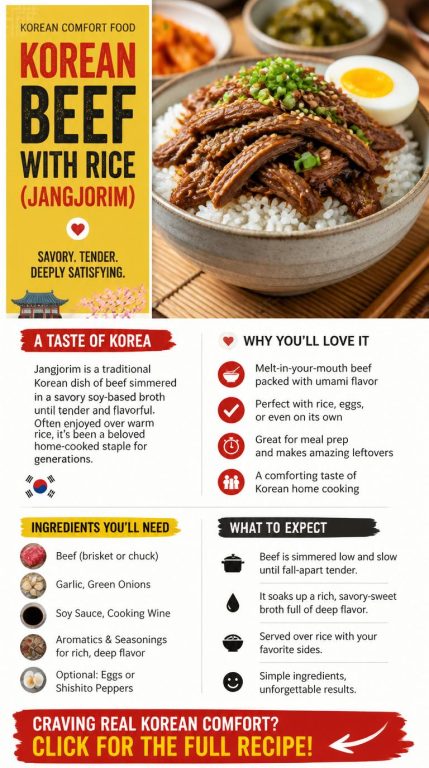
Jangjorim’s Many Guises: Exploring Regional Twists
I’ve realized that jangjorim isn’t just one thing. While the classic version sticks to beef and soy sauce, different regions and families love to add their own spin. Korean Beef with Rice is definitely not one-size-fits-all.
Pepper Variations That Pack a Punch
The most common twist? Peppers. Some folks toss in shishito peppers for a mild kick, while others go for green chili peppers to crank up the heat. My favorite find has to be kkwari gochu (꽈리고추), those wrinkly Korean peppers that look like they’ve seen things but taste incredible. Korean Beef with Rice just gets better with a little heat.
Protein Swaps
Not everyone sticks with beef. Pork jangjorim is a thing for folks who want a richer, fattier flavor. I won’t judge if you like it better, though beef purists might give you a look. Korean Beef with Rice is always open to interpretation.
Regional Add-Ins
| Common Addition | What It Brings |
|---|---|
| Quail eggs | Cute factor and extra protein |
| Mushrooms | Earthy depth |
| Regular chicken eggs | Budget-friendly bulk |
Some versions load up on boiled eggs and extra peppers, while traditional recipes focus on the beef. I’ve even seen people use honey instead of onions for sweetness. The cool thing about Korean Beef with Rice is that every family has their own “right” way to make it, and honestly, they’re all good.
Keeping It Fresh: Storing Your Savory Success
I always make a big batch of jangjorim because it stores so well in the fridge. Korean Beef with Rice is one of those rare dishes that actually improves as it sits.
Here’s how I keep mine fresh:
- Store the beef and eggs in an airtight container
- Keep everything submerged in the braising liquid
- Refrigerate within two hours of cooking
- Use a clean spoon every time—no double-dipping
The best part? Jangjorim lasts up to a week in my fridge. Korean Beef with Rice is basically my secret weapon for lazy dinners or quick lunches.
Storage times:
| Location | How Long |
|---|---|
| Refrigerator | 5-7 days |
| Freezer | Up to 3 months |
I’ve frozen jangjorim before, and it does okay. The beef texture changes a bit after thawing, but the flavor hangs in there. I freeze Korean Beef with Rice in small portions so I can just defrost what I need.
Pro tip: Let your jangjorim cool to room temp before sealing it up. Hot food makes condensation, and that just turns everything soggy and weird.
The braising liquid is gold. Don’t toss it! It keeps the meat juicy and full of flavor. Sometimes I use the extra liquid as a savory glaze for other dishes. Korean Beef with Rice just keeps on giving.
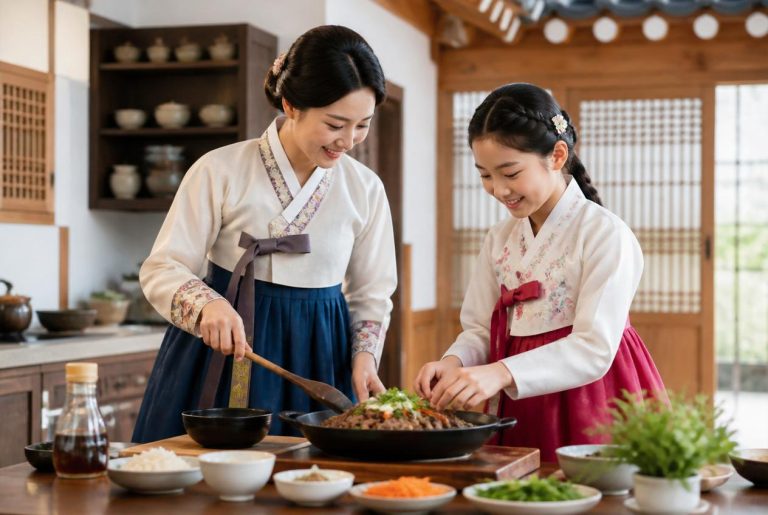
Korean Beef with Rice Recipe – Prep
Cooking Tips For the Korean Beef with Rice (Jangjorim)
• Cook the beef slowly so it becomes tender enough to shred easily.
• Shred or slice the beef evenly for more consistent texture.
• Simmer the sauce gently so the flavors absorb into the meat.
• Stir occasionally during cooking to help prevent sticking.
• Add eggs or other ingredients at the proper stage so they maintain texture.
• Use medium-low heat so the braising liquid reduces gradually.
• Taste before serving and adjust seasoning carefully if needed.
• Serve the jangjorim warm or chilled according to preference.
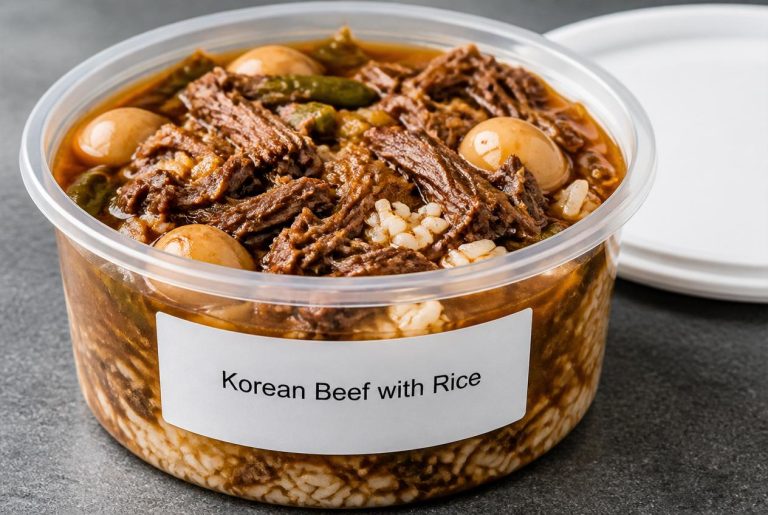
Korean Beef with Rice Recipe – Storage
Storage Tips For the Korean Beef with Rice (Jangjorim)
• Allow the beef and sauce to cool slightly before storing.
• Store leftovers in airtight containers to help retain moisture and flavor.
• Refrigerate leftovers within 2 hours of cooking for proper food safety.
• Keep the beef covered with some sauce during storage to help prevent drying.
• Reheat gently over low heat if serving warm.
• Store rice separately from the beef for better texture.
• Freeze the beef portion in freezer-safe containers for up to 3 months if needed.
• Leave slight space at the top of containers because liquids expand when frozen.
• Thaw frozen jangjorim overnight in the refrigerator before reheating.
• Discard the beef, eggs, or sauce if they develop a sour smell, slimy texture, discoloration, mold, or unusual taste.
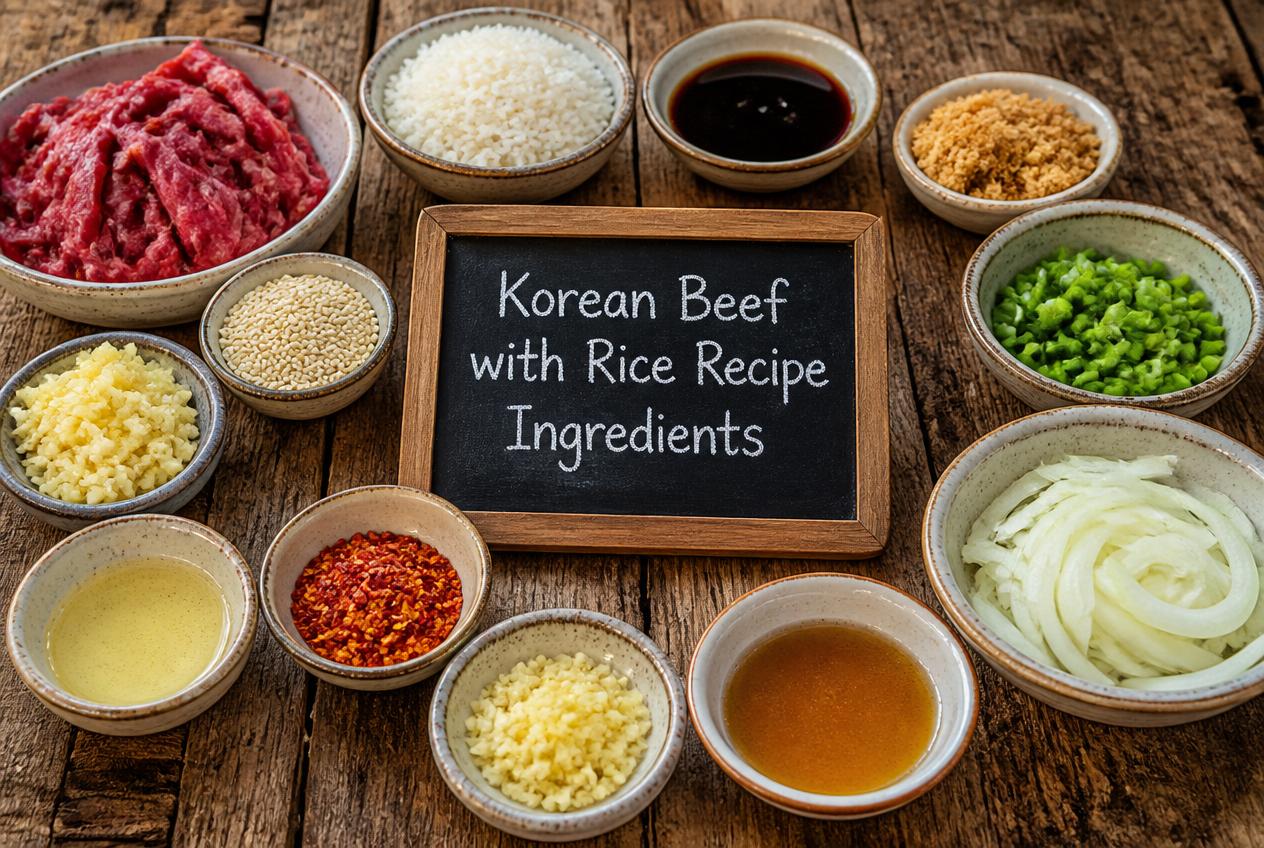
Korean Beef with Rice (Jangjorim)
Ingredients
- 1.5 pounds beef brisket flank steak, or shank meat
- 1/2 medium onion
- 2 scallions white part
- 6 ounces Korean radish mu, cut into big chunks
- 7 garlic cloves plump
- 3 ginger thin slices,about 1-inch round
- 1/2 teaspoon black peppers whole or ground peppers to taste
- 5 tablespoons soy sauce
- 2 tablespoons soup soy sauce guk ganjang (or use more regular soy sauce)
- 3 tablespoons sugar
- 3 tablespoons rice wine or mirin
Instructions
- Cut the beef into rectangles measuring approximately 2 to 3 inches in size. Keeping the pieces fairly large helps the meat remain tender during the long simmering process and makes it easier to shred later for serving.
- In a covered medium pot, combine 8 cups of water with the onion, scallion whites, Korean radish, garlic, ginger, and black pepper. Bring the mixture to a boil and continue cooking over medium-high heat for 5 minutes. This creates a flavorful base that will be used to cook the beef.
- Add the beef to the pot and return the liquid to a gentle boil. As the meat cooks, skim off any foam or impurities that rise to the surface. Reduce the heat to medium, cover the pot, and continue simmering for about 30 minutes. During this time, the beef will begin to tenderize while absorbing the flavors from the broth.
- Remove the beef from the pot and set it aside. Strain the cooking liquid into a large bowl, then return 2.5 cups of the strained liquid to the pot. Reserve the remaining broth for another use, such as soup or stew. Add the beef back to the pot along with all of the sauce ingredients. Bring everything to a boil over high heat.
- Once the liquid reaches a boil, reduce the heat to medium and cover the pot. Continue cooking until the beef becomes tender and the sauce reduces to about one-third of its original volume, approximately 20 minutes. If the meat is not as tender as desired, continue simmering until it reaches the preferred texture.
- If using the optional ingredients, add the dried kelp, peppers, and boiled eggs to the pot. Continue cooking for about 10 minutes so the ingredients absorb the flavor of the braising liquid. Remove and discard the dried kelp before proceeding.
- Transfer the beef, eggs, peppers, and sauce to an airtight container and allow everything to cool before refrigerating. When ready to serve, shred the beef into bite-sized pieces and spoon some of the flavorful sauce over the top. Serve alongside rice for a classic Korean meal.
Notes
10 to 12 Shishito peppers (or other fresh green peppers) Use less and cut into halves if using large peppers
3 boiled eggs, peeled
Frequently Asked Questions for the Korean Beef with Rice (Jangjorim)
Making jangjorim always brings up questions about meat cuts, saltiness, cooking tricks, and storage. Korean Beef with Rice isn’t complicated, but a few tips can make it even better.
What cut of beef works best for making that tender, shred-friendly Korean soy-braised beef?
Brisket is my favorite for traditional jangjorim because it’s got enough fat to stay moist during the long braise. The meat breaks down into tender, flaky pieces that soak up all that garlicky soy sauce. Korean Beef with Rice just isn’t the same with dry beef.
If I’m short on time, flank steak works too since it cooks faster. Eye round or beef eye round are leaner options, but you’ve got to watch them so they don’t dry out. Korean Beef with Rice is all about finding that balance—don’t use fancy ribeye, though, it’s a waste for this dish.
How do I keep the soy braising liquid from turning my dinner into a salt lick?
I start with less soy sauce than I think I need and taste as I go. The liquid reduces as it cooks, so the saltiness really concentrates.
Adding water or unsalted beef broth helps mellow things out. I also toss in a bit of honey or sugar, which is pretty traditional in Korean soy-braised beef recipes. If my batch ends up too salty, I just serve smaller portions with extra rice—Korean Beef with Rice can handle it. The rice soaks up all that flavor and balances everything out.
Can I make this Korean beef dish in a slow cooker without it turning into beef-flavored confetti?
My slow cooker is honestly perfect for Korean Beef with Rice, especially jangjorim, as long as I don’t crank it up and forget about it for half the day. Low and slow—seriously, that’s the trick here. I’ve ruined enough roasts to know better.
I usually set it on low for about 6-8 hours, or high for 3-4 if I’m in a hurry. The goal is tender meat, not a pile of sad beef shreds. Korean Beef with Rice really shines when the beef holds together just enough.
I like to check it right at the lower end of the time range. I’ll poke it with a fork—if it’s still tough, I give it another hour and check again. No shame in a little trial and error with Korean Beef with Rice.
How long should I pressure cook the beef so it’s juicy, not heartbreakingly dry?
With my Instant Pot, I go for brisket and cook it under high pressure for 45-60 minutes. This turns the toughest cut into something that actually works for Korean Beef with Rice, and honestly, it’s a relief not to chew forever.
I always let the pressure naturally release for at least 10 minutes before I open the lid. This keeps the meat from tightening up and getting dry, which would totally ruin the Korean Beef with Rice experience.
Eye round only needs about 35-40 minutes because it’s already more tender. I’ve learned (sometimes the hard way) that overcooking in a pressure cooker just wrecks Korean Beef with Rice—nobody wants dry, stringy beef.
How do I add eggs to the braise so they’re flavorful and not weirdly rubbery?
I hard boil the eggs separately, peel them, then drop them into the braising liquid for the last 15-20 minutes. That gives them enough time to soak up flavor for Korean Beef with Rice, but they don’t turn into rubber balls.
Quail eggs look adorable in jangjorim with eggs and work great for Korean Beef with Rice, but I usually just use regular chicken eggs. I cut them in half when serving because, well, it looks nice and they pick up more flavor.
If I’m storing Korean Beef with Rice, I leave the eggs in the liquid so they keep soaking up all that goodness. They’re even better after a day or two in the fridge, honestly. Korean Beef with Rice just gets tastier as it sits, which is kind of magical.
What’s the best way to store and reheat it so the rice doesn’t end up as a sad, soggy sidekick?
Honestly, I always stash the beef and rice in separate containers. If you mix them, you pretty much guarantee a mushy mess—nobody wants that. I keep the beef tucked away in an airtight container, chilling in the fridge for about a week. Make sure you pour in some of the braising liquid, or the beef dries out fast. Korean Beef with Rice really shines when you treat each part with a little care.
When it’s time to reheat, I just warm the beef gently in a pan or even the microwave, adding a splash of the braising liquid to keep it juicy. The rice? I zap it on its own in the microwave, but I always toss a little water on top and cover it with a damp paper towel. That trick saves it from turning into a brick. Korean Beef with Rice tastes so much better when the rice isn’t a soggy afterthought.
Freezing works for the braised beef—up to three months, no problem. But I skip freezing the eggs because, honestly, they just get weird and rubbery. I swear by using fresh rice for Korean Beef with Rice, but if I’m stuck with leftovers, day-old rice actually makes killer fried rice. Korean Beef with Rice is one of those dishes that’s forgiving, but if you want the best experience, fresh rice is the way to go. If you keep everything separate and reheat it right, Korean Beef with Rice never disappoints. I’ve tried shortcuts before, and every time, Korean Beef with Rice just tastes better with a little extra effort.

Recipes are gathered in person and written for real-world cooking conditions.
- 10 Hungarian Dessert Recipes Passed Down Through Generations - July 25, 2026
- 11 Easy English Recipes Anyone Can Make - July 25, 2026
- Hungarian Kifli Recipe - July 25, 2026