

German Bee Sting Cake, or Bienenstich, really stands out as one of the most beloved traditional German desserts you’ll spot in bakeries all over Germany. This classic German cake brings together two layers of soft yeast dough, a rich vanilla cream, and a crunchy caramelized honey almond topping. The mix of textures and flavors makes it a go-to for coffee breaks, celebrations, or just because you feel like treating yourself. If you’re on the hunt for a German Bee Sting Cake recipe that actually tastes like the real thing, this is it.
I’ll admit, making this authentic German dessert isn’t the fastest project, but the payoff is so worth it. The sweet, nutty topping gives the cake its signature “sting,” and the creamy filling keeps every bite light but still indulgent. If you’re looking for a German Bee Sting Cake recipe that impresses, this one delivers on both looks and flavor.
What I love about Bienenstich is how it balances all the elements—soft cake, creamy center, and that irresistible crunch. I’ll walk you through the classic German Bee Sting Cake recipe, ingredient swaps, and a few creative spins for making this classic German dish your own.
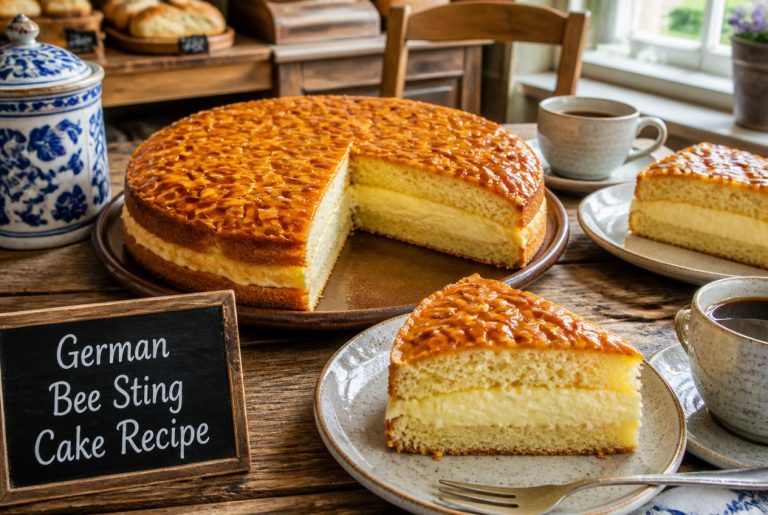
German Bee Sting Cake Recipe
Key Takeaways
- Bienenstich brings together yeast cake layers, vanilla cream, and a honey almond topping—the heart of any German Bee Sting Cake recipe
- This German Bee Sting Cake recipe takes a few steps, but you can swap ingredients and play with flavors
- The recipe is perfect for celebrations, afternoon coffee, or just exploring German baking at home
Origin and Story of Bienenstich
Bienenstich got its start in Germany and has been a staple in German kitchens for generations. The earliest German Bee Sting Cake recipe dates back to the early 1900s in both German and Swiss cookbooks.
The name “Bienenstich” literally means “bee sting.” The story behind it? I find it pretty entertaining. Legend says that in 1474, during a feud between Linz and Andernach, villagers defended their town by dropping beehives on attackers. They celebrated with—you guessed it—a German Bee Sting Cake recipe. Another tale claims a baker got stung by a bee drawn to the honey topping he’d just made.
The cake has roots in Bavaria and popped up in cookbooks from the 15th and 16th centuries. People served it at festivals and special occasions all over the region.
What makes a classic German Bee Sting Cake recipe?
- Sweet yeast dough as the base
- Vanilla custard or cream filling
- Caramelized almond and honey topping
The dessert spread from Bavaria to the rest of Germany. I’ve noticed that Bavarian recipes really prize the contrast: soft, bread-like base, crunchy almond top, and a smooth custard center. If you’re after a German Bee Sting Cake recipe that nails this balance, stick to the basics.
Expert Preparation Suggestions
I always prep my ingredients the night before when I make a German Bee Sting Cake recipe. The dough needs a good rise—at least two hours in total—so I plan ahead.
Timing tips for a perfect German Bee Sting Cake recipe:
- First rise: 60 minutes somewhere warm
- Second rise: 15-20 minutes after shaping
- Cooling: 30 minutes before you add the filling
I’ve learned that room temperature ingredients make a huge difference in any German Bee Sting Cake recipe. Cold butter won’t cream right, and cold milk can make the yeast sluggish.
For the honey-almond topping, I cook it until it’s a light golden color. I’ve burned it before—trust me, it happens fast. Let it bubble hard before you spread it on the dough.
I whisk the pastry cream constantly while it cooks. Medium heat works best, and if it gets lumpy, I just strain it through a fine mesh sieve.
Tools I always grab for a German Bee Sting Cake recipe:
- 9-inch springform pan
- Stand mixer with dough hook
- Heavy-bottomed saucepan
- Instant-read thermometer
I let the cake layers cool completely before adding the filling. If you rush, the cream melts and turns into a mess. Patience really pays off with a German Bee Sting Cake recipe.
For better results, I always measure flour by weight—it keeps my German Bee Sting Cake recipe consistent every time.
Creative Flavor Twists
I can’t help but experiment with every German Bee Sting Cake recipe I try. The classic is great, but sometimes you want something new that still feels familiar.
One twist I love is a chocolate version—swap almond extract for vanilla and add cocoa powder to the pastry cream. It’s rich, but the honey-almond topping keeps it grounded in the German Bee Sting Cake recipe tradition.
Fruit-Based Variations
Fresh berries in the cream filling? Absolutely. Strawberries, raspberries, blueberries—they all work and add a little tang. Lemon zest in the custard gives a bright, citrusy lift to your German Bee Sting Cake recipe.
Nut Alternatives
Almonds are classic, but I’ve swapped in other nuts for a new spin:
- Hazelnuts—deeper, earthier flavor
- Pistachios—unique color and taste
- Pecans—buttery and rich
Spice Additions
Sometimes, I add spices to shake things up. Cardamom with the honey topping is amazing, and cinnamon in the custard adds warmth. A splash of orange blossom water in the cream? It’s subtle but lovely in a German Bee Sting Cake recipe.
Dietary Adaptations
For gluten-free needs, a gluten-free German Bee Sting Cake recipe with almond flour gives a denser cake but keeps the flavor on point. Toasting the almond flour first makes it even better.
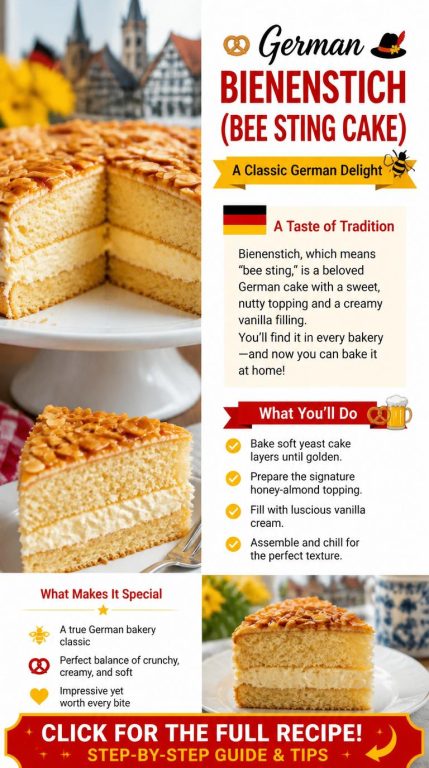
Ingredient Swaps and Alternatives
I like to keep my German Bee Sting Cake recipe flexible. Sometimes, you just don’t have everything in the pantry, and that’s fine.
For the yeast dough, I’ll use bread flour instead of all-purpose for a chewier bite. No active dry yeast? Instant yeast works just as well—just mix it with the dry stuff.
When I’m short on time, I swap pastry cream for vanilla pudding, or blend whipped cream with pudding for a lighter German Bee Sting Cake recipe filling.
Swaps I use in my German Bee Sting Cake recipe:
- Butter – Margarine or coconut oil works in a pinch
- Whole milk – Almond or oat milk for dairy-free
- Honey – Maple syrup or agave nectar for similar sweetness
- Sliced almonds – Chopped walnuts, pecans, or hazelnuts for crunch
For a gluten-free German Bee Sting Cake recipe, I use a 1:1 gluten-free flour blend. The texture is a little different, but it holds together nicely.
Dairy-free topping? Vegan butter does the trick. The caramelized nut layer still turns golden and crisp. I’ve even used coconut sugar instead of regular sugar for a less refined option in my German Bee Sting Cake recipe.
It’s all about making the German Bee Sting Cake recipe work for you and whoever you’re baking for—no need to stress about perfection.
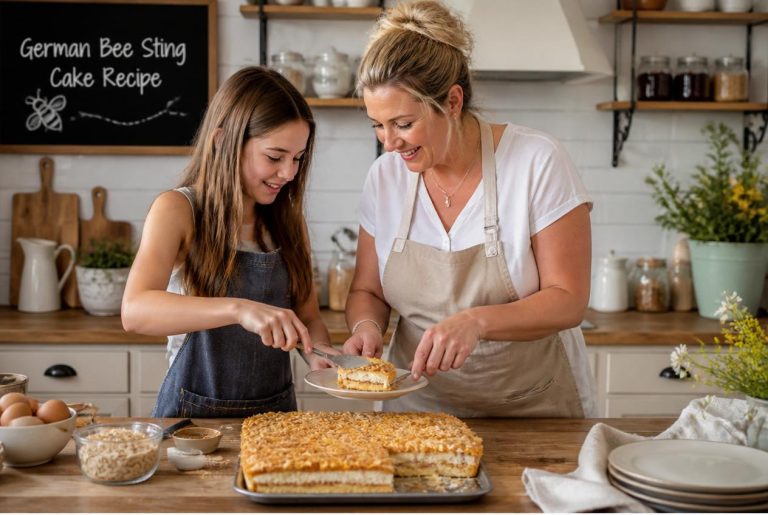
German Bee Sting Cake Recipe Cooking TIps
German Bee Sting Cake (Bienenstich) Recipe Cooking Tips
• Bienenstich is known for its soft yeast cake, crunchy caramelized almond topping, and creamy filling.
• A light yeast dough forms the traditional base and provides a soft, airy texture.
• Warm milk helps activate the yeast and encourages a good rise.
• Butter adds richness and tenderness to the cake.
• Allow the dough sufficient time to rise for the lightest texture.
• The signature topping is made from butter, sugar, honey, and sliced almonds.
• Honey contributes the classic flavor associated with Bee Sting Cake.
• Spread the almond topping evenly before baking for consistent caramelization.
• Watch the cake carefully near the end of baking because the honey-almond topping can brown quickly.
• Allow the cake to cool completely before slicing and filling.
• Traditional fillings often include pastry cream, whipped cream, or a combination of both.
• Chilling the filling before assembly helps it remain stable when sliced.
• Use a serrated knife to split the cake layers cleanly.
• Refrigerate briefly after assembly to help the filling set.
• The flavor should balance sweet honey almonds, soft cake, rich cream, and buttery notes.
• Bienenstich is one of Germany’s most beloved bakery cakes and is often served with coffee.
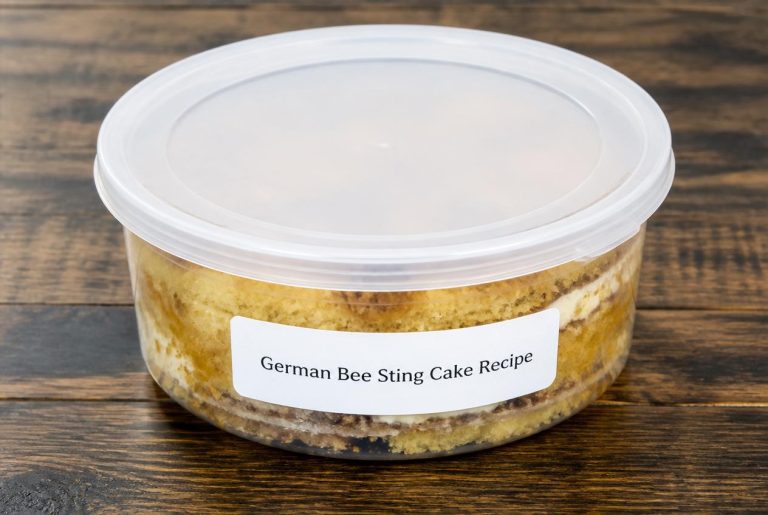
German Bee Sting Cake Recipe Storage TIps
German Bee Sting Cake (Bienenstich) Storage Tips
• Keep the assembled cake refrigerated because of the cream filling.
• Store in an airtight container to help maintain freshness.
• Refrigeration may slightly soften the almond topping, which is normal.
• Serve chilled or allow a short time at room temperature before serving.
• The honey and almond flavors often deepen after overnight refrigeration.
• Cover the cake well to prevent it from absorbing refrigerator odors.
• Freeze unfilled cake layers separately if desired.
• Cream-filled cakes generally freeze less successfully because the filling texture may change.
• Defrost frozen cake layers gradually at room temperature before filling.
• Store leftover slices in a single layer whenever possible.
• Use clean utensils when handling leftovers to help maintain freshness.
• Cream-filled desserts are generally best enjoyed within a short refrigerated storage period for ideal quality and safety.
• Keep away from strongly scented foods because cream-based desserts absorb odors easily.
• Slight settling of the filling during storage is normal.
• Discard leftovers if the filling develops sour odors, separation, mold, or unusual texture changes.
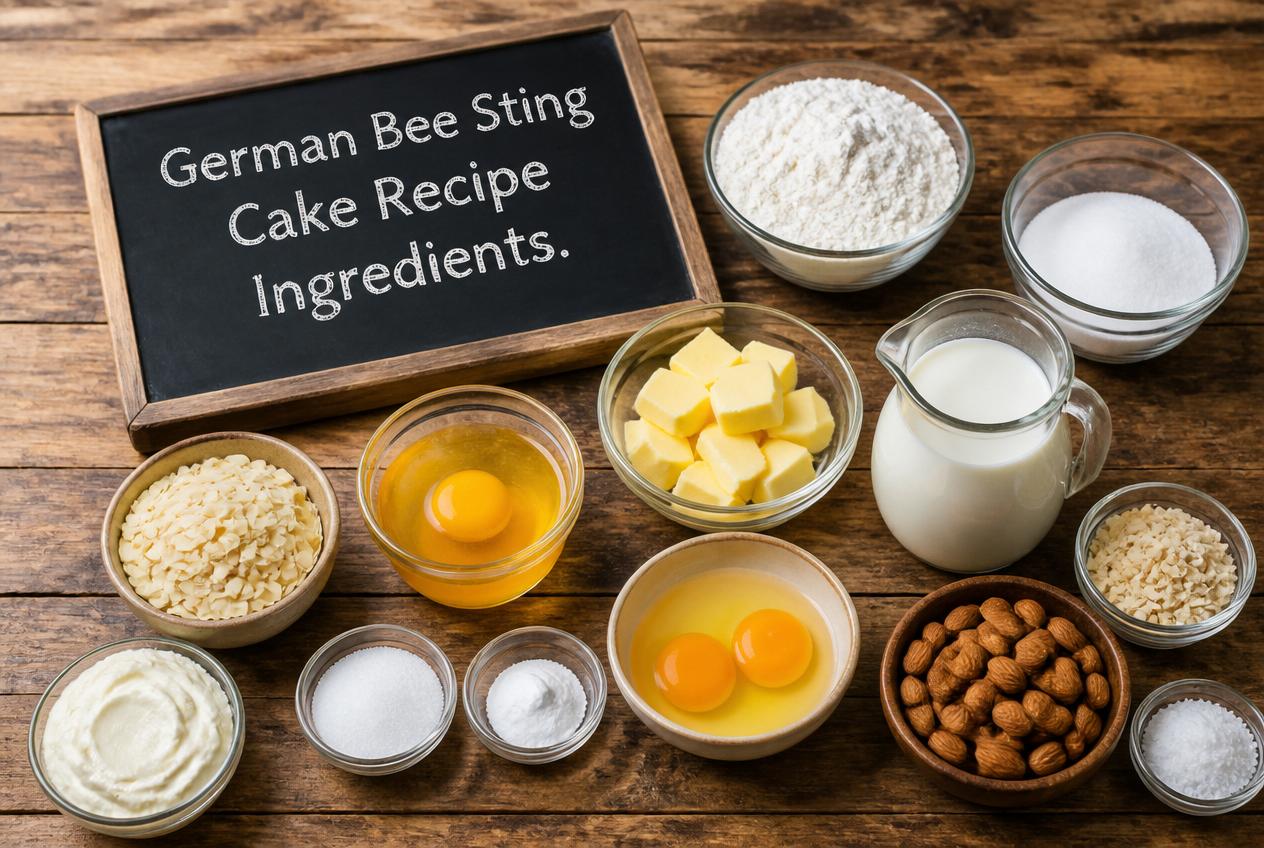
German Bee Sting Cake Recipe (Bienenstich)
Ingredients
- 1/3 cup sugar
- 3 tablespoons cornstarch
- 1/4 teaspoon salt
- Yolks from 3 large eggs
- 1 1/2 cups whole milk
- 1 teaspoon vanilla extract
- 1/2 cup heavy whipping cream
- 1/4 cup whole milk
- 1/4 cup unsalted butter
- 2 tablespoons honey
- 2 large eggs
- 2 1/3 cups bread flour
- 1 3/4 teaspoons yeast
- 1/4 teaspoon salt
- 1/4 cup unsalted butter
- 2 tablespoons honey
- 2 tablespoons sugar
- 1 cup sliced almonds
Instructions
- To make the filling, begin by combining the sugar, cornstarch, and salt in a medium heatproof mixing bowl. Whisk thoroughly to distribute the cornstarch evenly, which will help prevent lumps from forming later.
- Add the egg yolks and whisk vigorously until the mixture becomes smooth, pale, and creamy. At first, the mixture may appear dry and crumbly, but continue whisking and it will gradually loosen into a smooth paste.
- Slowly add the milk a small amount at a time, whisking constantly after each addition. This gradual process ensures a silky-smooth custard base without lumps. Continue until all of the milk has been incorporated and the mixture is completely smooth.
- Pour the custard mixture into a saucepan and place it over medium-low heat. Cook while whisking constantly, making sure to scrape the bottom and corners of the pan to prevent scorching.
- After approximately 5 minutes, the mixture will begin to thicken and gently simmer. Once small bubbles appear, continue cooking and whisking for 1 additional minute. This extra cooking time fully activates the cornstarch and eliminates any starchy taste.
- Remove the saucepan from the heat and immediately whisk in the vanilla extract until fully incorporated.
- Pour the hot pastry cream through a fine-mesh strainer into a clean bowl. Straining removes any small lumps and ensures an exceptionally smooth filling.
- Press a sheet of plastic wrap directly onto the surface of the pastry cream to prevent a skin from forming. Refrigerate while you prepare the cake dough and topping. The custard should become completely chilled before it is folded with the whipped cream later.
- In a small saucepan, combine the milk and butter and heat over low heat just until the butter melts. Remove from the heat and allow the mixture to cool until lukewarm. It should feel warm but not hot to the touch.
- Pour the milk mixture into the bowl of a stand mixer fitted with a dough hook. Add the honey, eggs, bread flour, yeast, and salt.
- Mix on low speed for about 1 minute, just until the ingredients come together into a rough dough. Increase the speed to medium-low and continue kneading for approximately 6 minutes. The dough should become smooth, elastic, and slightly tacky without sticking heavily to the bowl.
- Transfer the dough to a lightly greased bowl and cover with plastic wrap or a clean kitchen towel.
- Place the bowl in a warm, draft-free location and allow the dough to rise until doubled in size, about 1 hour. During this time, the yeast will develop flavor and create the light texture characteristic of Bee Sting Cake.
- While the dough rises, prepare the signature almond topping.
- In a small heavy-bottomed saucepan, combine the butter, honey, and sugar. Place over medium heat and cook until the sugar dissolves completely and the mixture begins to bubble gently.
- Remove the pan from the heat and stir in the sliced almonds until they are evenly coated. Set aside and allow the topping to cool slightly. As it cools, it will thicken into a glossy almond mixture.
- Lightly grease a 9-inch springform pan with butter. Dust the bottom and sides with flour, then tap out any excess.
- Once the dough has doubled in size, gently punch it down to release excess air. Transfer it to the prepared pan and use your fingertips to gently press and stretch the dough evenly across the bottom.
- Spread the cooled almond topping over the entire surface of the dough, distributing the almonds evenly from edge to edge.
- Cover the pan loosely and allow the dough to rise again in a warm place until doubled in size, approximately 30 minutes.
- During this second rise, the dough will become lighter and prepare for baking.
- About 20 minutes before baking, position a rack in the center of the oven and preheat to 350°F.
- Bake the cake for 25–30 minutes, or until the top is deeply golden and the almond topping is bubbling around the edges. The cake should feel set in the center and spring back lightly when touched.
- Remove the cake from the oven and allow it to cool in the pan for about 20 minutes. This resting period helps the almond topping firm up and makes the cake easier to handle.
- Run a knife around the edge of the springform pan and carefully remove the outer ring. Transfer the cake to a wire rack and allow it to cool completely before filling.
- While the cake cools, prepare the final cream filling.
- In the bowl of a stand mixer fitted with the whisk attachment, beat the heavy whipping cream on medium-high speed until stiff peaks form, about 1–2 minutes. The whipped cream should be thick and hold its shape when the whisk is lifted.
- Remove the chilled pastry cream from the refrigerator and whisk until smooth and creamy. Fold half of the whipped cream into the pastry cream using a rubber spatula until mostly combined. Then gently fold in the remaining whipped cream until the mixture is completely smooth, light, and airy.
- The finished filling should be silky, fluffy, and stable enough to hold its shape when spread inside the cake.
- Once the cake has cooled completely, carefully slice it horizontally into two layers using a long serrated knife. Lift off the almond-topped upper layer and set it aside.
- Spread the cream filling evenly over the bottom half of the cake, creating a thick, smooth layer. Carefully place the almond-topped layer back on top.
- For the cleanest slices, refrigerate the assembled cake for 30–60 minutes before serving. Slice with a sharp serrated knife and serve chilled or slightly cool.
- This traditional German Bee Sting Cake (Bienenstich) combines a soft honey-enriched yeast cake, crunchy caramelized almond topping, and a luxurious vanilla cream filling, creating one of Germany's most beloved bakery desserts.
German Bee Sting Cake (Bienenstich) Recipe Frequently Asked Questions
If you’re new to making a German Bee Sting Cake recipe at home, you probably have questions. I’ve picked up a few tricks for ingredients, the almond topping, getting the custard just right, and keeping leftovers fresh.
What ingredients do I need to make this cake at home?
For the cake base, I use flour, yeast, milk, sugar, butter, and eggs. The honey almond topping needs sliced almonds, honey, butter, and sugar.
For the filling, I make a custard with milk, egg yolks, sugar, cornstarch, and vanilla extract. Sometimes, a splash of heavy cream makes it extra rich—totally optional in your German Bee Sting Cake recipe.
How do I make the almond-honey topping without it burning or turning bitter?
I cook the butter, honey, sugar, and almonds over medium-low, stirring the whole time. I let it bubble gently for about 3-4 minutes, watching for that golden color.
If the topping gets too dark, it’ll taste bitter. As soon as it’s light caramel, I pull it off the heat. I spread it on the dough before baking so it caramelizes just right in the oven. I keep my oven at 350°F for the best results in my German Bee Sting Cake recipe.
What is the best custard or cream filling to use, and how do I keep it from getting runny?
I stick with a vanilla custard cream—egg yolks, milk, sugar, and cornstarch—for my German Bee Sting Cake recipe. Cornstarch thickens it and keeps it from running.
I cook the custard until it coats the back of a spoon, then cool it completely. Sometimes, I fold in whipped cream for a lighter touch.
I always chill the custard for at least 2 hours before using it in my German Bee Sting Cake recipe. This helps it set and hold its shape between the layers.
How do I know when the cake is fully baked but still soft and tender?
I check with a toothpick—it should come out clean or with a few moist crumbs. My German Bee Sting Cake recipe usually bakes for 20-25 minutes at 350°F.
The edges pull away from the pan, and the top feels springy when I press it. The almond topping turns golden and smells amazing.
I never overbake—the yeast dough dries out fast. The cake should feel soft when I take it out. That’s the sign of a German Bee Sting Cake recipe done right.
Can I make it ahead of time, and how should I store it to keep it fresh?
You can totally prep this German Bee Sting Cake recipe ahead of time. I usually bake the cake layers and whip up the custard filling separately, then stash them in the fridge. When I feel like it, or when guests are coming over, I’ll assemble the German Bee Sting Cake recipe—usually a day before I want to serve it. That way, everything tastes fresh but I’m not scrambling at the last minute.
For storing the German Bee Sting Cake recipe, I tuck the finished cake into an airtight container and keep it in the fridge. It’ll stay good for about three days. The custard filling in this German Bee Sting Cake recipe really needs to stay cold, or it just goes weird and loses its texture. I’ve learned that the hard way—don’t let it sit out too long.
When it’s time to serve, I like to let the German Bee Sting Cake recipe sit out of the fridge for half an hour. That short wait makes a big difference in flavor and texture. Freezing? Not really a fan. The custard in this German Bee Sting Cake recipe just doesn’t handle freezing well. It separates and turns watery, and honestly, nobody wants that. If you’re planning to try this German Bee Sting Cake recipe, stick to the fridge and eat it up within a few days for the best experience.
Where can I buy a good version locally, and what should I look for when choosing one?
I usually hunt down authentic German bakeries or those quirky European specialty shops around town that actually make a real German Bee Sting Cake recipe. When you find a place where the bakers know their German Bee Sting Cake recipe inside out, you’re off to a good start. Some of these spots even have bakers who grew up making the German Bee Sting Cake recipe back home, which is always a plus in my book.
When I’m eyeing a cake, I want that almond topping to be golden and caramelized—definitely not pale, but please, not burnt either. The German Bee Sting Cake recipe should give you those lovely, visible layers and a solid amount of cream filling sandwiched in the middle. If the German Bee Sting Cake recipe skimps on the filling, it’s just not right. I’ll be honest, sometimes I even ask to peek at a slice before I buy. Why not?
It’s worth asking when they baked the cake. The German Bee Sting Cake recipe really shines when it’s fresh—ideally within a day or two of being put together. You want the German Bee Sting Cake recipe to deliver a soft, slightly springy texture, not something that feels dry or sad. If you’re lucky, you might find a bakery that bakes the German Bee Sting Cake recipe daily, and that’s always worth a detour. So, yeah, I get a little picky, but when you’ve tasted a perfect German Bee Sting Cake recipe, there’s no going back.

Recipes are gathered in person and written for real-world cooking conditions.
- 10 Hungarian Dessert Recipes Passed Down Through Generations - July 25, 2026
- 11 Easy English Recipes Anyone Can Make - July 25, 2026
- Hungarian Kifli Recipe - July 25, 2026