
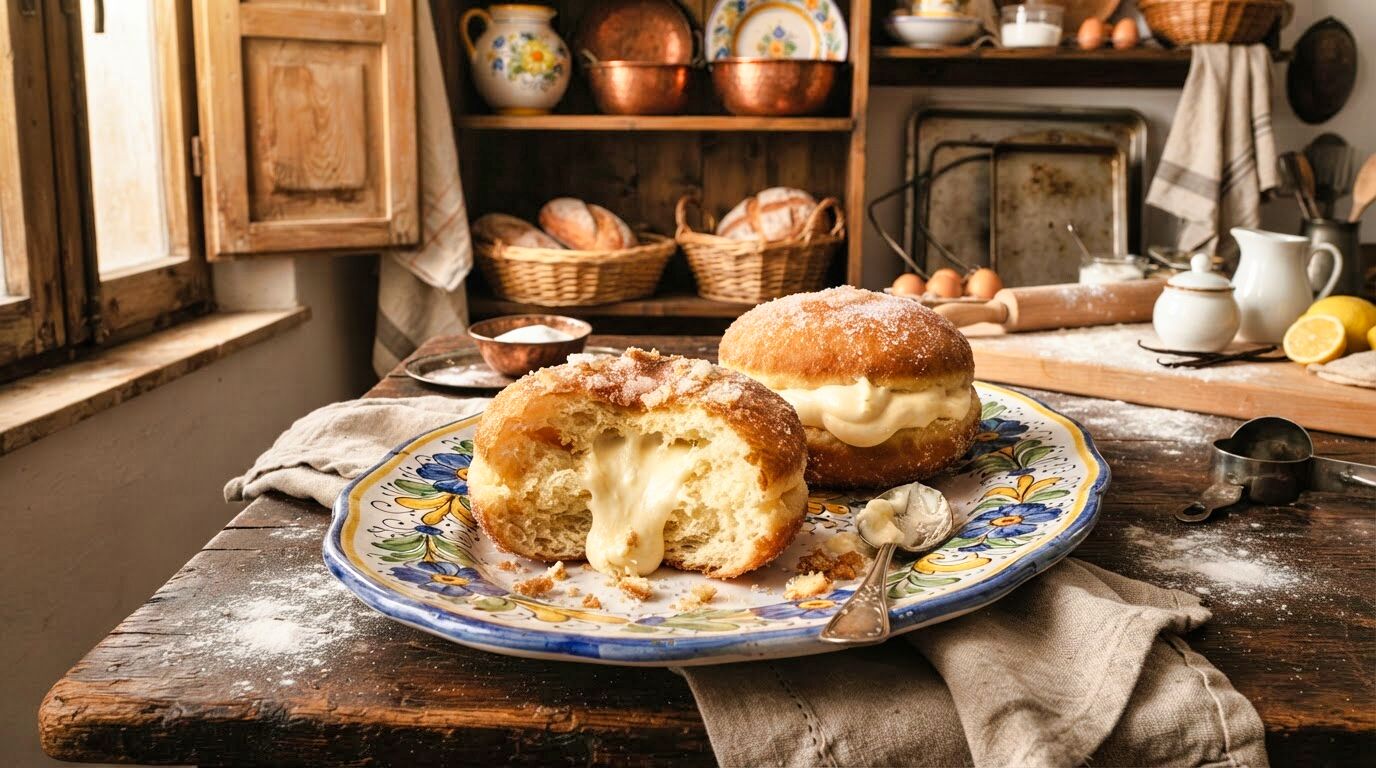
You can actually make pillowy, sugar-dusted Italian bomboloni at home—honestly, it’s easier than you might think. The Italian Bomboloni recipe calls for an enriched yeast dough and a creamy filling, so every bite has this soft, slightly eggy crumb and a sweet, gooey center. If you’re after that bakery-style treat, this is the way to go.
This Italian Bomboloni recipe gives you a clear walkthrough, plus some practical tips that make all the difference. I’ll show you how to get the dough texture right, keep your frying temperature steady, and fill those doughnuts like a pro. Even if you’re new to Italian desserts, you’ll pull off bomboloni that are light and stuffed just right.
Description, Recipe, and Historical Information
Bomboloni are those round, filled Italian doughnuts you see in pastry shops, made from a rich yeasted dough. With this Italian Bomboloni recipe, you’ll mix up a soft dough using all-purpose flour, or sometimes a blend with bread or 00 flour, let it rise, then fry until golden. The result? Classic, fried bomboloni that are hard to resist.
For the filling, pipe in Italian pastry cream (crema pasticcera) made from whole milk, eggs, sugar, and butter. Or, if you want to experiment, try pistachio cream, hazelnut spread, homemade Nutella, lemon curd, or even fruit preserves. This Italian Bomboloni recipe really shines with a silky vanilla custard, but honestly, use what you love.
The basic Italian Bomboloni recipe? Mix flour, sugar, egg yolks, yeast (fresh or instant), salt, and warm milk. Knead it until it’s smooth and stretchy, let it rise, then shape and fry. When they’re still warm, roll the doughnuts in powdered sugar and pipe in the filling with a tip. Some folks bake them for a lighter twist, and that works too if you’re into it.
Historically, the name comes from “bomba” or “bombe” in Italian, a nod to that plump, stuffed shape that’s ready to burst with filling. You’ll spot regional takes all over Italy—some bakers add extra butter for richness, others swap in potato or bread flour for a different texture. If you want to see a traditional technique in action, check out a classic Italian Bomboloni recipe from a trusted source. There’s just something about these cream-filled treats that keeps people coming back.

Cooking Tips
If you want the Italian Bomboloni recipe to turn out just right, watch your oil temperature. Grab a heavy pot and heat the vegetable oil for frying to around 350–360°F (175–180°C). When the oil’s too hot, you’ll end up with dark outsides and raw centers. If it’s too cool, the bomboloni get greasy. I always toss in a tiny bit of dough first to test the temp before frying the whole batch. The Italian Bomboloni recipe really benefits from this little check.
For a fluffy crumb in your Italian Bomboloni recipe, knead the dough until it’s smooth and just a bit tacky. Kneading by hand or with a dough hook for a few extra minutes makes a world of difference. Wait until the dough doubles in size—yeah, it takes patience, but it’s worth it. The Italian Bomboloni recipe just doesn’t work as well if you rush this step.
Eggs matter more than you’d think in an Italian Bomboloni recipe. Use room temperature eggs for a dough that comes together easily and rises the way it should. Cold eggs can slow everything down and make your dough stiff. If you forget to take them out ahead, just warm them up in your hands for a minute.
Chill your filling a bit before piping it into the Italian Bomboloni recipe—trust me, it helps. Use a piping bag with a narrow tip, poke it into the side of a warm (not hot) doughnut, and squeeze gently. Don’t go overboard or you’ll split the doughnut. The Italian Bomboloni recipe shines when you hit the right balance.
After frying, move the bomboloni onto a parchment-lined baking sheet so they don’t sit in oil. Let them drain for a minute, then roll them in sugar or dust as you like. I always fry in small batches to keep the oil temperature steady. Consistency is key with any Italian Bomboloni recipe, and this trick helps every time.
Classic Italian Bomboloni Recipe
Ingredients
- 4 cups all-purpose flour
- 3 large eggs beaten at room temperature
- 6 tablespoon butter softened and cut into cubes
- ½ cup granulated sugar
- ½ cup whole milk warmed
- 1 teaspoon vanilla extract
- 2 ¼ teaspoons active dry yeast
- 1 pinch salt
- Zest of 1 orange or lemon optional, but traditional to Italian donuts
- ½ cup sugar granulated or confectioners sugar for rolling doughnuts
- oil Sunflower or vegetable for frying
- 4 medium egg yolks
- ½ cup granulated sugar
- ½ cup cornstarch
- 2 cups whole milk
- ½ teaspoon vanilla bean scrape the inside of a vanilla bean pod. You can also use 1 tsp of good quality pure vanilla extract (optional substitute: almond extract)
Instructions
- Activate the Yeast
- Pour the warm milk into a small bowl.
- Sprinkle the yeast over the surface and leave it undisturbed for 5 minutes.
- Stir the mixture after the resting time.
- The yeast should begin to bubble. If it does not, discard the mixture and start again with fresh yeast.
- Place the flour, sugar, and salt in the bowl of a stand mixer.
- Whisk until the ingredients are evenly combined.
- Pour the milk and yeast mixture into the dry ingredients.
- Add the beaten eggs, orange zest, and vanilla.
- Fit the stand mixer with the dough hook attachment.
- Knead until the ingredients come together.
- Stop the mixer and scrape down the sides and bottom of the bowl.
- Scatter the butter cubes evenly over the dough mixture.
- Knead on low speed for 10 minutes.
- The finished dough should become smooth and elastic while remaining slightly sticky.
- Lightly grease your hands.
- Transfer the dough to a clean cutting board or work surface.
- Knead it by hand 2 to 3 times, forming it into a smooth ball.
- Do not add any additional flour during this step.
- Lightly oil a clean bowl and place the dough inside.
- Cover securely with plastic wrap.
- Leave the dough in a warm, draft-free location for 2 to 3 hours.
- Allow it to rise until it has tripled in size.
- Transfer the dough to a clean, lightly floured work surface.
- Punch it down once to release the excess air.
- Knead several times until it forms a smooth ball again.
- Flatten the dough first with your hands.
- Using a rolling pin, shape it into a rectangle approximately 1/2 inch thick.
- Use a round cookie cutter or glass to cut out donuts approximately 3 1/2 inches in diameter.
- Save the leftover dough scraps for frying if desired.
- Alternatively, knead the scraps together, roll them out again, and cut additional donuts.
- Line a baking sheet with parchment paper.
- Arrange the cut donuts on the prepared sheet.
- Cover loosely with plastic wrap or a clean towel.
- Leave them to proof for 1 to 1 1/2 hours, or until they have tripled in size.
- Pour oil into a large, deep pan or Dutch oven.
- Heat the oil to 340°F to 350°F (170°C to 175°C), checking the temperature with a frying thermometer.
- Line a baking sheet with paper towels for draining the fried donuts.
- Place sugar in a separate bowl for coating.
- Cut the parchment paper into individual squares so each donut remains on its own piece.
- Avoid touching the risen dough as much as possible because handling may cause the donuts to deflate.
- Carefully lower each donut into the hot oil while still resting on its parchment square.
- Quickly remove the parchment with tongs and discard it.
- Cook the donuts in batches without overcrowding the pan.
- Fry for approximately 2 minutes on each side.
- Lift the cooked donuts from the oil with a slotted spoon.
- Place them on the paper towel-lined baking sheet for several minutes to drain away excess oil.
- While still warm, roll each donut in the prepared sugar.
- Allow the coated donuts to cool before adding the filling.
- Make sure the pastry cream is fully chilled and the sugar-coated donuts have cooled slightly.
- Using a small knife, make an opening in the side of each donut.
- Gently move the knife inside to create enough space for the filling.
- Transfer the pastry cream or another desired filling to a piping bag.
- Insert the tip into the opening in each donut.
- For the best results, serve the filled donuts immediately.
- Any leftovers may be stored in plastic containers for 1 to 2 days.
- These homemade Bomboloni are soft, airy Italian donuts scented with orange zest and vanilla, fried until golden, and rolled generously in sugar. Filled with smooth pastry cream or another favorite filling, they're a rich and irresistible treat that's especially delicious when served fresh.
- Beat the Egg Yolks and Sugar
- Place the egg yolks and sugar in a medium mixing bowl.
- Using an electric mixer, beat for approximately 5 minutes.
- Continue until the mixture becomes pale, light, and foamy.
- Add the Cornstarch
- Pour the cornstarch into the whipped egg yolk mixture.
- Beat for another 1 to 2 minutes, or until completely smooth and evenly combined.
- Pour the milk into a saucepan and warm it over low heat.
- Add the lemon zest and vanilla bean or vanilla extract.
- Stir to distribute the flavorings throughout the milk.
- Heat the Milk
- Increase the heat to medium.
- Continue warming until the milk reaches a gentle boil.
- Look for small bubbles forming around the sides of the pan and steam beginning to rise from the surface.
- Remove the saucepan from the heat as soon as the milk reaches this stage.
- Combine the Egg Mixture and Hot Milk
- Begin whisking the hot milk continuously.
- Gradually add the beaten egg yolk, sugar, and cornstarch mixture a little at a time.
- Keep whisking without stopping as each addition is incorporated.
- Continue until the mixture becomes completely smooth and uniform.
- Return the saucepan to low heat.
- Whisk continuously while the mixture gently cooks for approximately 3 to 4 minutes.
- Continue until the pastry cream begins to thicken.
- Do not allow the cream to boil at any point, as gentle heat helps prevent lumps and pieces of cooked egg from forming.
- If using a cooking thermometer, keep the temperature below 185°F (85°C).
- If bubbles begin appearing in the cream, immediately lower the heat.
- The saucepan may also be removed from the burner for a few seconds before returning it to the low heat.
- Keep the pastry cream over very low heat until it reaches the proper consistency.
- The finished cream should cling to the back of a wooden spoon without dripping off.
- As soon as the cream has thickened, immediately pour it into a cold glass container.
- Do not leave the finished cream in the hot saucepan, as the residual heat will continue cooking it.
- While the pastry cream cools, place plastic wrap directly against its surface.
- Make sure the plastic remains in contact with the cream.
- This prevents a skin from developing as it cools.
- Transfer the covered pastry cream to the refrigerator.
- Chill for at least 3 hours to allow it to fully set.
- This smooth homemade Pastry Cream combines rich egg yolks, milk, vanilla, and fresh lemon zest into a thick, silky custard. Slowly cooked over gentle heat and chilled until fully set, it's a versatile filling for cakes, pastries, tarts, and other classic desserts.

Recipes are gathered in person and written for real-world cooking conditions.
- 10 Hungarian Dessert Recipes Passed Down Through Generations - July 25, 2026
- 11 Easy English Recipes Anyone Can Make - July 25, 2026
- Hungarian Kifli Recipe - July 25, 2026