
If you’re craving a real taste of Lebanon, you can whip up a Lebanese manoushe zaatar recipe at home with just a handful of ingredients—think simple dough, olive oil, and that unmistakable za’atar blend. This isn’t just any flatbread; it’s the Lebanese answer to pizza, but way faster and arguably more addictive. You’ll get those crispy edges, a chewy middle, and all you really need are three pantry staples. I mean, what’s not to love?
Let’s walk through the steps: shaping, topping, and getting why za’atar and olive oil just work so well together. There’s a bit of history here too—man’oushe isn’t just breakfast, it’s a slice of Lebanese culture. I’ll share straightforward tips for that perfect blistered crust, plus some tweaks if you want to riff on the classic Lebanese manoushe zaatar recipe. Maybe you like it a bit spicier? Or with a cheesy twist? There’s room to play.
Description, Recipe and Historical Information
Man’oushe (sometimes you’ll see it spelled manakish or manakeesh) is a Lebanese flatbread you eat hot, usually for breakfast or when you need a snack that actually satisfies. The classic Lebanese manoushe zaatar recipe uses a topping of za’atar—this herby, tangy blend of thyme, sumac, toasted sesame seeds, and sometimes marjoram or oregano—mixed with good olive oil until it’s a spreadable paste.
To make the dough for a Lebanese manoushe zaatar recipe, grab some bread flour, a pinch of active dry yeast, water, salt, and a splash of oil. Roll out small rounds, slather on that za’atar and olive oil mix, then bake them hot and fast. You want those edges to blister and the sesame seeds to get toasty. Trust me, the smell alone is worth it.
Every Lebanese manoushe zaatar recipe seems to have its own twist. Some families love extra sumac for more zing, others go heavy on the sesame for that nutty kick. You can swap in a bit of crumbled feta or a swipe of labneh if you’re feeling indulgent, or shake on some Aleppo chili for a gentle burn. There’s no single right way, which honestly keeps things interesting.
Man’oushe goes way back in Levantine street food history. Lebanese bakeries and homes still turn out stacks of these every morning. Making a Lebanese manoushe zaatar recipe connects you to a tradition that’s lasted centuries—herbs and sesame on bread, simple but kind of genius. These days, you’ll find wood-fired classics and modern oven-baked versions all over Lebanon and beyond.
If you want a solid Lebanese manoushe zaatar recipe with clear steps, check out this detailed guide to making authentic Lebanese man’oushe with za’atar topping. It’s easy to follow and lets you tweak things to your own taste, which, in my opinion, is half the fun of baking at home. Give this Lebanese manoushe zaatar recipe a try, and you’ll see why it’s such a staple. You might even end up making a Lebanese manoushe zaatar recipe part of your regular breakfast rotation. Or lunch. Or—let’s be honest—anytime you want.

Cooking Tips
Crank your oven as hot as it’ll go—like 475–550°F (245–290°C)—and let a pizza stone or baking stone preheat for half an hour. That’s the secret to those blistered, crispy edges you crave in a Lebanese manoushe zaatar recipe.
Grab a pizza peel or even just a flat baking sheet, and dust it with semolina or fine cornmeal. That way, your dough won’t stick and you can slide your Lebanese manoushe zaatar recipe right onto the hot stone. No one likes a stuck flatbread.
Got a saj or convex griddle hanging around? Use it! Cooking man’oushe straight on a saj gives you that authentic char and bakes the Lebanese manoushe zaatar recipe super fast. The heat’s intense and even, so the edges crisp up while the crumb stays chewy.
I always aim for a dough that’s a bit shaggy with plenty of air pockets—don’t overwork it. That’s what makes the Lebanese manoushe zaatar recipe soft and open inside. Handle it gently when you shape it, or you’ll just squash those lovely bubbles.
When it comes to za’atar, less is more. Spread the mixture thinly and evenly—too much oil and you’ll end up with a soggy Lebanese manoushe zaatar recipe. Press the topping in just a bit so it bakes right into the dough instead of sliding off in the oven.
If you want those edges extra crisp, pop the Lebanese manoushe zaatar recipe under the broiler for 30–60 seconds. Keep a close eye on it and give it a quick turn so the za’atar doesn’t burn. It’s easy to get distracted, but don’t walk away.
Serve your Lebanese manoushe zaatar recipe warm, maybe as part of a mezze platter with labneh, olives, and fresh veggies. Honestly, it’s best eaten right away, but if you have leftovers, reheat the Lebanese manoushe zaatar recipe on a hot stone for a minute or so—brings the texture right back. There’s just something about that fresh-from-the-oven vibe you can’t beat. And if you’re anything like me, you’ll probably want to make the Lebanese manoushe zaatar recipe again before the week’s out.
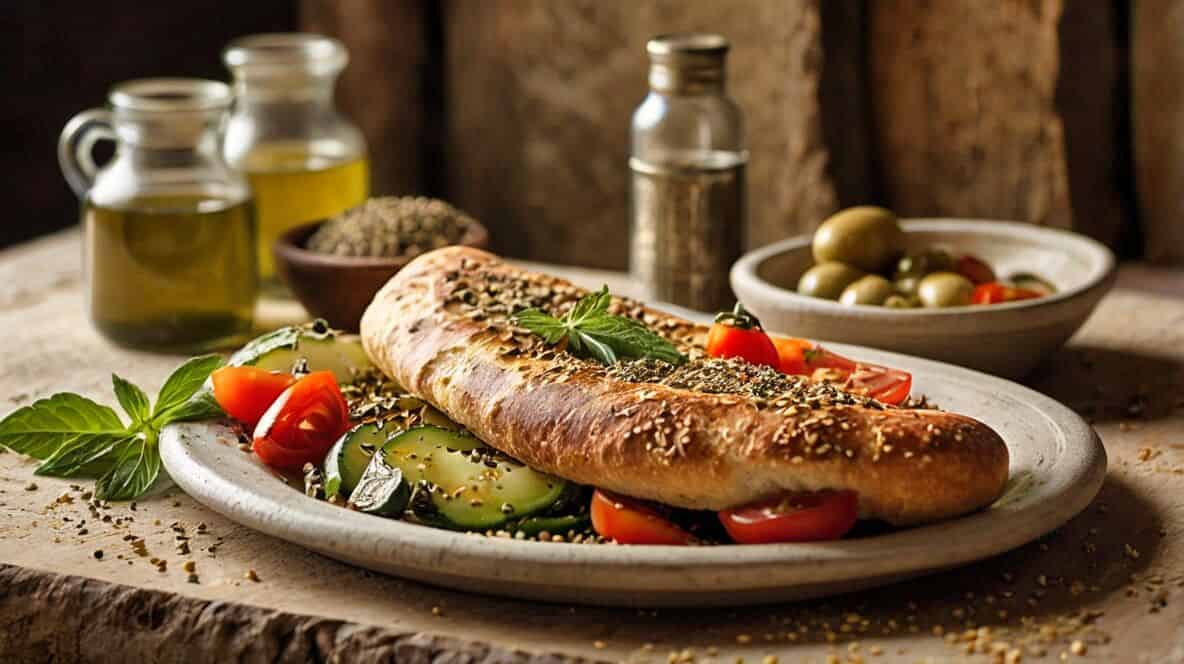
Lebanese Manoushe, Zaatar Recipe
Ingredients
- 2 1/2 cups all-purpose flour unbleached
- 1 cup cake flour
- 2 teaspoons kosher salt
- 1 1/4 cups water 90-100 degrees
- 1 teaspoon active dry yeast
- 1 tablespoon sugar
- 1 tablespoon oil such as canola or safflower
- 1/2 cup za’atar
- 1/2 cup olive oil extra virgin
- Garnishes: tomatoes picked turnips, mint, arugula, labneh, etc.
Instructions
- In a large mixing bowl, combine the all-purpose flour, whole wheat flour, and salt.
- Whisk the dry ingredients together until evenly blended.
- In a small bowl, combine the yeast and sugar.
- Slowly stir in ¼ cup of the lukewarm water until dissolved.
- Set the mixture aside for about 10 minutes, or until it becomes foamy and active.
- Pour the activated yeast mixture and the oil into the flour mixture.
- Gradually add the remaining warm water while mixing until a soft dough forms.
- Transfer the dough to a lightly floured surface and knead for about 10 minutes, or until it becomes smooth, soft, and elastic.
- If using a food processor, allow it to run for about 1 minute after all of the water has been added, until the dough forms a smooth ball.
- First Rise
- Place the dough into the bowl and turn it once so the entire surface is lightly coated with oil.
- Cover with plastic wrap and a clean kitchen towel.
- Leave the dough in a warm place for 1½ to 2 hours, or until it has doubled in size.
- Turn the risen dough onto a lightly floured surface.
- Divide it into 4 equal portions and shape each one into a smooth ball.
- Dust the dough balls lightly with flour.
- Cover them again with plastic wrap and a kitchen towel, then allow them to rest for 20 minutes.
- Place a baking stone or an inverted baking sheet on the lowest rack of the oven.
- Preheat the oven to 400°F for 20 to 30 minutes.
- If using a convection oven, preheat it to 425°F instead.
- In a small bowl, combine the za'atar seasoning with the oil.
- Stir until the mixture forms a smooth, spreadable paste.
- Set it aside until ready to use.
- Lightly flour your work surface, rolling pin, and pizza peel or an inverted baking sheet.
- Place one dough ball on the floured surface and flatten it gently with your hand.
- Roll the dough into a round about ¼ inch thick, turning it frequently as you work to maintain an even circle and prevent sticking.
- Spread about 3 teaspoons of the za'atar mixture evenly over the surface of the dough.
- Leave about ½ inch around the edge uncovered to form a border.
- Carefully transfer the prepared flatbread onto the floured peel.
- Slide the dough onto the hot baking stone or preheated baking sheet.
- Bake for 7 to 10 minutes, or until the edges are lightly golden and the bread is fully cooked.
- Watching through the oven window can help you monitor the browning without opening the oven door.
- Remove the finished flatbread to a wire rack and allow it to cool for a few minutes.
- The topping may appear slightly oily while hot but will settle as it cools.
- Repeat the shaping and baking process with the remaining dough balls.

Recipes are gathered in person and written for real-world cooking conditions.
- 10 Hungarian Dessert Recipes Passed Down Through Generations - July 25, 2026
- 11 Easy English Recipes Anyone Can Make - July 25, 2026
- Hungarian Kifli Recipe - July 25, 2026