
A Indonesian Salad recipe can look impressive and taste amazing without much effort. Gado Gado brings together blanched or raw veggies, boiled eggs, and crispy tofu or tempeh, all tied together with a creamy, tangy peanut sauce. That sauce? It somehow balances savory, sweet, and a little heat—pretty genius. If you’re after a colorful, healthy meal that comes together fast and satisfies a crowd, the Indonesian Salad recipe is a no-brainer.
Let’s dig into what sets gado gado apart, peek at the culture behind this dish, and pick up some practical tips for getting that peanut sauce just right. I’ll walk you through the basics and ingredient swaps, and we’ll hit some common questions so you can serve this Indonesian Salad recipe with real confidence.
The Story Behind the Salad
Indonesian salads kind of blur the line between snack and full meal. They’re shaped by history, trade, and everyday routines. You’ll notice how fresh produce and bold dressings work together, making every bite a little sweet, spicy, sour, and savory. That’s the magic of an Indonesian Salad recipe—seriously, it’s never boring.
Gado gado might be the most recognizable version. It pairs steamed or blanched veggies, boiled eggs, and fried tofu with a thick peanut sauce that’s rich but not overwhelming. The Indonesian Salad recipe really shows off how much this cuisine loves playing with texture and flavor.
Street vendors and home cooks both put their spin on these salads. Some toss in lontong (rice cake) or krupuk (crackers) for crunch, while others go heavy on raw fruit and chilis. Honestly, you’ll see a different Indonesian Salad recipe in every region.
The dressings—called bumbu—tell the story of spice routes and local markets. You’ll catch hints of tamarind, palm sugar, chilies, and peanuts, all woven into the Indonesian Salad recipe through years of trade and tradition.
When you make this at home, just think of it as a living recipe. Sure, you can stick to classic gado gado, but swap veggies, tweak the heat, and make the Indonesian Salad recipe your own. Why not?
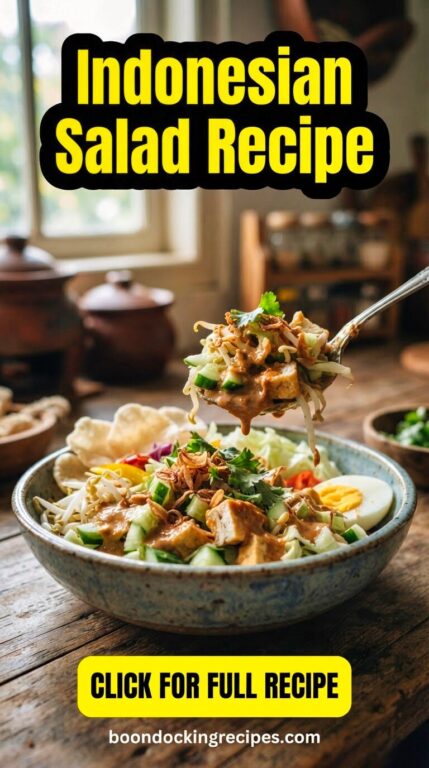
Easy Tips for Making It Awesome
Keep your peanut sauce smooth and balanced—don’t overthink it. Go with natural peanut butter, then thin it with a little warm water or coconut milk for a creamy feel. A squeeze of lime juice and a smashed garlic clove really brighten up the Indonesian Salad recipe.
Want that authentic gado gado kick? Stir in a hit of kecap manis (sweet soy sauce) and a pinch of palm sugar. Just taste as you go; you want the sauce sweet-salty-sour, not sticky. The Indonesian Salad recipe should taste lively, not heavy.
Handle the heat your way. Mix in sambal oelek or chili paste to your liking—no need to go overboard. Leave extra chili on the side so everyone can spice up their Indonesian Salad recipe to taste.
Prep veggies for the best texture. Give spinach, beansprouts, and sliced potatoes a quick blanch—they should stay tender-crisp. Slice English cucumber thin for that cool, crunchy contrast. It’s all about making the Indonesian Salad recipe pop.
Layer in textures. Top your salad with crushed peanuts and a sprinkle of fried shallots. Serve with lontong or steamed rice and a handful of krupuk for that classic Indonesian Salad recipe crunch.
Don’t fuss about plating. Arrange veggies in color blocks, drizzle on the peanut sauce, and finish with a lime wedge. Leftover sauce? Pop it in the fridge—it thickens, so just whisk in some warm water or coconut milk before using it again in your Indonesian Salad recipe.
Indonesian Salad Recipe
Ingredients
- 2 chilies fresh Thai or small bird’s eye
- 3 cloves garlic
- 8 ounces peanuts about 1 1/2 cups roasted unsalted
- 2 tablespoons soy sauce kecap manis Indonesian sweet soy sauce
- 1 tablespoon brown sugar packed dark
- 1 teaspoon fish sauce
- 1 teaspoon rice vinegar
- 1 teaspoon kosher salt
- 3/4 cup water plus more as needed
Instructions
- Remove the stems from the Thai or bird’s eye chilies.
- Cut the chilies roughly in half.
- Place the chilies and peeled garlic cloves in a food processor fitted with the blade attachment.
- Pulse about 8 times in 1-second bursts, or until coarsely chopped and combined.
- Add the roasted unsalted peanuts.
- Pulse about 25 times in 1-second bursts, or until finely ground.
- Season the Peanut Sauce
- Add the kecap manis, dark brown sugar, fish sauce, rice vinegar, and kosher salt.
- Pulse about 15 times in 1-second bursts until thoroughly combined.
- Measure ¾ cup of water.
- Pour about half of the water into the food processor.
- Pulse about 15 times in 1-second bursts.
- Continue pulsing while gradually pouring in the remaining water.
- Process until the sauce is smooth and pourable without becoming too thin.
- If needed, add more water 1 tablespoon at a time.
- The finished recipe should make about 2 cups of sauce.
- Place the eggs in a large saucepan.
- Add enough cold water to fill the pan about three-quarters full.
- Bring the water to a boil over medium-high heat.
- Remove the saucepan from the heat.
- Cover and let the eggs stand for 10 minutes.
- While the eggs cook, fill a medium bowl halfway with ice and cold water.
- Prepare the Vegetables
- Remove the core from the cabbage.
- Cut it into ½-inch-wide shreds to make about 5 cups.
- Trim the ends from the green beans.
- Cut the chayote into ½-inch pieces without peeling it.
- Line a baking sheet with paper towels.
- Using a slotted spoon, transfer the cooked eggs to the ice-water bath.
- Return the saucepan of water to a boil.
- Add the cabbage and cook for about 2 minutes, or until tender.
- Transfer it to the prepared baking sheet with a slotted spoon.
- Bring the water back to a boil before adding the next vegetable.
- Blanch the Green Beans
- Add the green beans to the boiling water.
- Cook for 1 to 2 minutes, or until bright green and crisp-tender.
- Transfer them to the baking sheet.
- Blanch the Bean Sprouts
- Return the water to a boil.
- Add the bean sprouts and cook for about 1 minute, or until tender.
- Transfer them to the baking sheet.
- Bring the water back to a boil.
- Add the chayote and cook for 4 to 5 minutes, or until fork-tender.
- Transfer it to the baking sheet.
- Return the water to a boil.
- Add the spinach and cook for about 2 minutes, or until wilted and tender.
- Transfer it to the baking sheet.
- Prepare the Tempeh and Tofu
- Cut the tempeh into 1-inch-long triangles about ¼ inch thick.
- Cut the firm tofu into 1-inch cubes.
- Heat 1 tablespoon of neutral oil in a large nonstick skillet over medium-high heat.
- Once the oil is shimmering, add the tempeh.
- Cook for 2 to 3 minutes per side, or until crisp and golden brown.
- Transfer it to a plate.
- Add the remaining tablespoon of neutral oil to the same skillet.
- Add the tofu.
- Cook for 4 to 5 minutes, turning as needed, until golden and crisp on at least 2 sides.
- Transfer it to the plate with the tempeh.
- Prepare the Fresh Vegetables
- Cut each Roma tomato into 8 wedges.
- Slice the Persian cucumbers crosswise into ½-inch-thick rounds.
- Cut the lime into wedges.
- Remove the eggs from the ice-water bath.
- Peel them and cut each egg in half lengthwise.
- Assemble the Gado-Gado
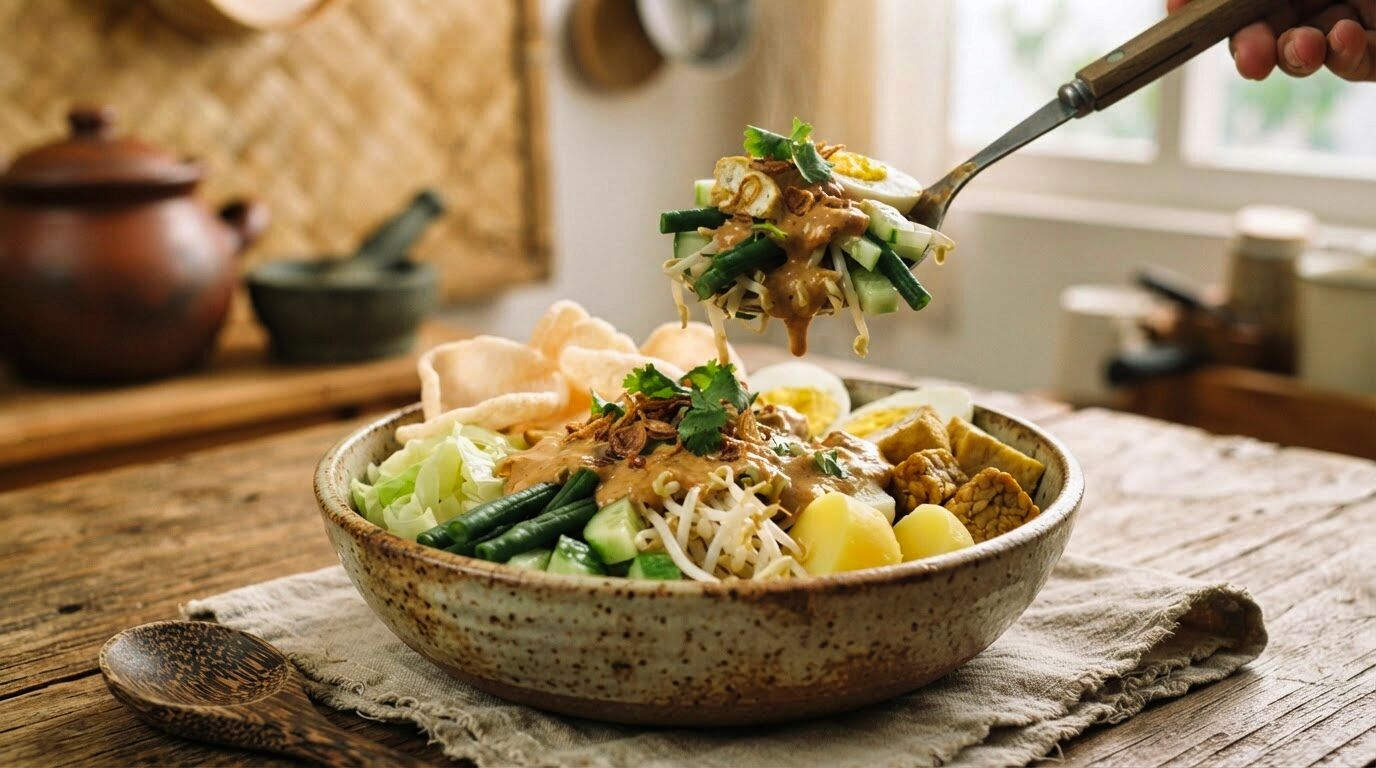
- Arrange the cooked and fresh vegetables, eggs, tempeh, and tofu on a large platter or in a wide, shallow serving bowl.
- Drizzle approximately ¼ cup of the peanut sauce over the top.
- Garnish with fried shallots.
- Serve with lime wedges, fried shrimp chips, and the remaining peanut sauce on the side.
- This colorful Indonesian gado-gado combines blanched and fresh vegetables, crisp tofu, golden tempeh, and boiled eggs with a rich, spicy peanut sauce. Fin
Frequently Asked Questions
Let’s hit the practical stuff you’ll want to know while making an Indonesian Salad recipe: how to throw together a quick version, which veggies and proteins work best, how to nail the peanut sauce, and what sets gado gado apart from other salads.
What’s the easiest way to make a quick Indonesian-style salad at home?
Blanch green beans, cabbage, and spinach for a couple of minutes, then shock them in ice water so they stay crisp-tender. Add thin-sliced cucumber and steamed potato for substance, then top with fried tofu or crispy tempeh. This is the heart of the Indonesian Salad recipe.
If you’re short on time, grab pre-made peanut sauce—just tweak it to taste. Finish your Indonesian Salad recipe with crushed krupuk or roasted peanuts for crunch and a soft- or hard-boiled egg for extra protein.
Which veggies are typically used in a classic Indonesian mixed salad?
Blanched green beans, cabbage, spinach, bean sprouts, and cucumber are all classics. Steamed or boiled potato, carrot ribbons, and sometimes long beans show up often in an Indonesian Salad recipe.
Mix fresh and cooked for contrast—cold blanched veggies with warm fried tofu or tempeh is a winner. Keep everything bite-sized so the peanut sauce coats each piece in your Indonesian Salad recipe.
How do you make a peanut sauce that tastes like the authentic version?
Toast or fry raw peanuts, then blend with palm sugar, tamarind or lime juice, garlic, chili, kecap manis, and warm water until it’s thick and pourable. Play with salt, sweetness, and acidity until your Indonesian Salad recipe hits that savory, sweet, and tangy balance.
If you use peanut butter, choose natural and unsweetened. Thin it with warm water, soy or tamarind, and a little sugar. Tossing tofu or tempeh with a spoonful of sauce before serving helps the Indonesian Salad recipe come together.
What’s the difference between gado-gado and other Indonesian salads?
Gado-gado centers on a thick, savory-sweet peanut sauce with blanched veggies, fried tofu or tempeh, and boiled eggs. It’s usually a main dish. Other Indonesian salads might highlight raw veggies, lighter dressings, or regional touches like coconut or fish-based condiments, but the Indonesian Salad recipe always brings that signature sauce and texture mix.
Gado-gado goes for a real texture party—soft potatoes, crisp beans, creamy peanut sauce, and crunchy krupuk. Other salads might focus more on raw components or lighter dressings, but the Indonesian Salad recipe keeps things hearty.
Can I make the peanut dressing ahead of time, and how should I store it?
Definitely. Make the peanut dressing one or two days ahead, let it cool, then stash it in an airtight container in the fridge. When you’re ready, bring it to room temp and whisk in a little hot water so it’s smooth again for your Indonesian Salad recipe.
If the sauce thickens up, just thin it with warm water, lime juice, or a splash of soy. That way, it’ll coat your veggies perfectly in your next Indonesian Salad recipe.
What are the best protein add-ins (like tofu or tempeh) to serve with it?
Fried tofu and crispy tempeh really bring that satisfying contrast—one soft, one crunchy—and both soak up peanut sauce like a dream. I usually pan-fry tempeh slices until they turn golden, or cube and deep-fry tofu for that perfect crispy bite. After that, I’ll toss them with a splash of sauce or kecap manis. It just elevates the whole Indonesian Salad recipe experience, you know?
Hard- or soft-boiled eggs? Honestly, they add a little richness and make everything more filling. Sometimes, I’ll throw in grilled chicken or shrimp if I’m not sticking to vegetarian. They both fit surprisingly well with the Indonesian Salad recipe. I’d say experimenting with these proteins keeps the dish interesting. Whenever I make an Indonesian Salad recipe, I always end up trying something new.

Recipes are gathered in person and written for real-world cooking conditions.
- Indonesian Stir-Fried Water Spinach Recipe - July 20, 2026
- Indonesian Spicy Chili Shrimp Recipe - July 20, 2026
- Indonesian Fried Noodles Recipe - July 20, 2026